



Glosarium dan Memori Terjemahan untuk SEO
Pelajari bagaimana glosarium terjemahan dan memori terjemahan (TM) menjaga istilah merek, konsistensi entitas, serta versi bahasa yang mengutamakan pengguna di situs web multibahasa—tanpa membuat teks terasa usang.
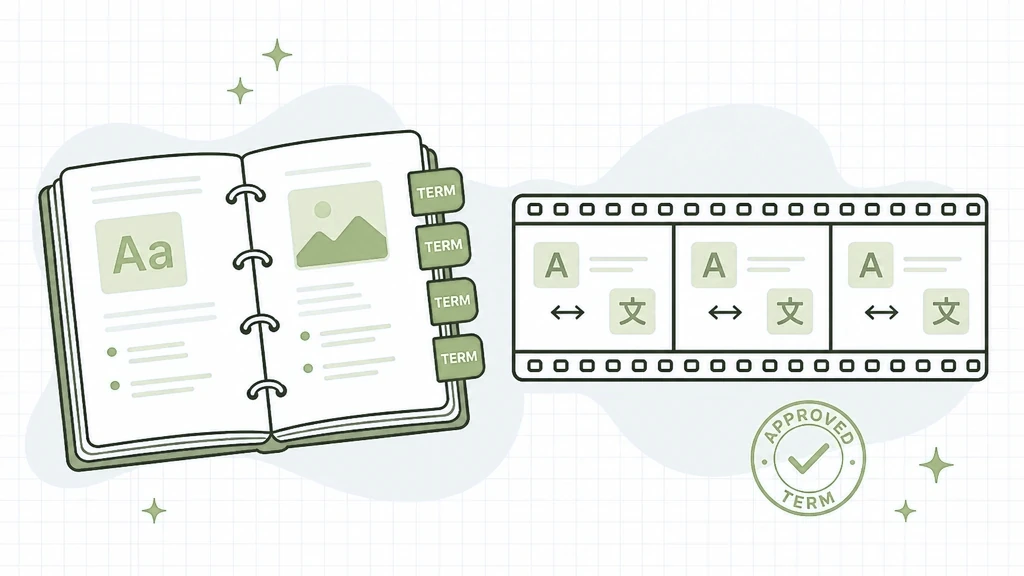
SEO and localization teams often share a goal: publish language versions that users trust and search engines can interpret. Glossaries and translation memory (TM) are the operational layer that keeps terminology consistent while you scale. Without them, the same product might appear under three different names in French, hreflang clusters stay technically valid, and the on-page language signal still weakens because visible copy drifts.
This guide explains what glossaries and TM do, how terminology drift hurts multilingual SEO, and how to govern both without freezing outdated copy or blocking MTPE workflows.
Pertanyaan yang dijawab dalam panduan ini
- What is a translation glossary and how does it differ from TM?
- How do inconsistent terms hurt multilingual SEO and entities?
- Which terms belong in a glossary for website programs?
- How should TM reuse support scale without freezing outdated copy?
- How do glossary rules interact with MTPE workflows?
- How should SEO keyword variants be handled across languages?
- What governance model keeps glossary and TM current?
- How do glossary/TM features show up in translation platforms?
Quick answer: consistency compounds across locales
Quick answer: A translation glossary defines approved terms, brand language and SEO-sensitive vocabulary per locale. Translation memory stores previously translated segments for reuse. Glossaries enforce what to say; TM accelerates how fast you say it consistently. Together they protect entity clarity across crawlable language URLs—especially when Google determines page language from visible content, not from hreflang or lang attributes alone.
Consistency compounds: one inconsistent product name across ten locale URLs creates ten slightly different entity signals. Google recommends distinct crawlable URLs per language version; your terminology systems make each URL read as a coherent language experience rather than a mixed-language template.
Glossary vs translation memory
A translation glossary (terminology database) is a curated list of source terms with approved target-language equivalents, usage notes, and often “do not translate” rules for brand names. Glossaries are prescriptive: they tell translators, reviewers and machine translation engines which word to use for “workspace,” “plan,” or a regulated claim.
Translation memory is a bilingual database of previously translated sentence or segment pairs. When new content resembles past work, TM suggests matches—exact or fuzzy—for reuse. TM is descriptive history: it reflects what was approved before, not necessarily what marketing wants tomorrow.
| System | Primary job | SEO relevance |
|---|---|---|
| Glosarium | Lock brand, product and compliance terms | Stable entity labels in titles, H1s, nav and body |
| TM | Reuse vetted phrasing at scale | Faster publishing without reinventing terminology each sprint |
They solve different problems. A glossary without TM still leaves writers free to paraphrase around approved terms. TM without a glossary reuses whatever was translated last quarter—including outdated product names. Mature website programs use both, connected to the same CMS or translation platform.
SEO impact of terminology drift
How do inconsistent terms hurt multilingual SEO and entities?
Google determines page language primarily from visible content. Language versions should keep content and navigation predominantly in one language. When the same concept appears under multiple labels—“multilingual SEO platform” on one page and a different product descriptor on another—users and search systems receive a noisier topical signal.
Terminology drift also creates mixed-language experiences: English product names left untranslated in otherwise Spanish navigation, or half-localized UI strings beside fully localized body copy. Google helpful-content guidance prioritizes people-first pages; thin or boilerplate-only language versions are weak SEO and weak answer sources. Consistent, people-first language versions help users and search systems understand topical clarity.
Hreflang annotations tell Google about alternate language or regional URLs and must be reciprocal across the set of pages they describe—but hreflang does not fix confusing on-page language. Each language version should remain predominantly in one language, including navigation and core product terminology users expect.
Bing Webmaster Guidelines similarly emphasize crawlable, useful content and clear site structure for indexing across markets. Terminology consistency supports that clarity; it is not a documented ranking factor by itself.
What to put in a website glossary
Which terms belong in a glossary for website programs?
Start with terms that appear in high-visibility, high-risk surfaces:
- Brand and product names (translate, transliterate, or protect)
- Plan and feature names referenced in titles, meta descriptions and H1s
- Category and navigation labels repeated across templates
- Compliance and legal phrases where variation creates risk
- SEO keyword targets agreed per locale—not literal English exports, but approved local equivalents tied to research
- UI microcopy in headers, buttons and empty states
- Integration and partner names with official spellings
For each entry, document: source term, approved translation, forbidden alternatives, part of speech, context note (“use on pricing pages only”), and owner. Link glossary entries to URL patterns when terminology differs by section (marketing site vs docs).
Avoid bloating the glossary with every common word. Focus on terms whose variation would confuse users or split entity recognition across locales.
TM reuse without stale copy
How should TM reuse support scale without freezing outdated copy?
TM is powerful for repetitive website content: footers, feature blurbs, security statements, and help snippets. It becomes a liability when product marketing rebrands but TM keeps serving old matches at high fuzzy-match scores.
Practical controls:
- Segment aging — flag TM units older than a release cycle for revalidation
- Match thresholds — require human review for fuzzy matches on glossary-controlled terms
- Source updates — when English source changes materially, deprecate affected TM units instead of auto-propagating
- Glossary precedence — glossary hits override TM suggestions when they conflict
- Version tags — tie TM batches to product versions or content pillars
- Periodic TM pruning — archive segments tied to retired pages or deprecated features
The goal is speed with guardrails, not maximum reuse at any quality cost. Google does not rank TM usage; users and crawlers respond to whether the published language version still reads as helpful and current.
Keyword variants across languages
How should SEO keyword variants be handled across languages?
Do not treat English keyword lists as direct translation input. Approved local keyword variants belong in the glossary as preferred renderings when they reflect in-market research—not as forced insertions into every sentence.
Workflow:
- Research demand in the target language and market (see dedicated international keyword research guidance).
- Agree primary and secondary phrasing per locale with SEO and localization owners.
- Add approved variants to the glossary with usage context (“title/H1 acceptable,” “body only,” “avoid in legal copy”).
- Train MT and MTPE reviewers to respect glossary SEO entries as hard constraints where marked
- Revisit after launch using Search Console queries per property or directory
Each language or locale URL should have a clear canonical that prefers the same-language preferred URL when duplicates exist. Keyword alignment across locales supports that clarity; keyword stuffing does not.
MTPE and glossary enforcement
How do glossary rules interact with MTPE workflows?
Machine translation post-editing (MTPE) sits between raw MT and human translation. Glossaries should feed the MT engine before post-editing begins so reviewers fix style and flow—not basic terminology errors repeatedly.
In MTPE workflows:
- Pre-MT: apply glossary to the engine and lock “do not translate” entries
- During edit: highlight glossary violations in the CAT or TMS UI
- QA pass: automated glossary checks before publish
- Feedback loop: editors propose glossary updates when MTPE surfaces systematic gaps
Glossary enforcement is especially important on pages Google must read as predominantly one language. Mixed-language segments from inconsistent MTPE erode the visible-language signal even when hreflang and sitemaps are correct.
Governance and ownership
What governance model keeps glossary and TM current?
Assign clear owners:
| Asset | Typical owner | Cadence |
|---|---|---|
| Glosarium | Localization lead + SEO + legal | Monthly review; ad hoc on launches |
| TM | Localization ops | Quarterly prune; immediate on rebrand |
| SEO keyword entries | SEO lead per region | After research cycles and GSC reviews |
Run a lightweight change process: propose → review (SEO + legal if needed) → publish to TMS → notify vendors. Track glossary version in release notes so engineers know which TM/glossary snapshot shipped.
Connect governance to site architecture: when you add crawlable URLs for new languages, confirm XML sitemaps help discovery of language versions and can carry hreflang annotations when used as an implementation method. Terminology work lands last-mile on those URLs.
Daftar periksa implementasi
Use this checklist when standing up or auditing glossary and TM for SEO:
How glossary and TM features show up in translation platforms
How do glossary/TM features show up in translation platforms? In practice, you should expect four integration points:
- Authoring and CMS export — source pages export translatable segments with stable IDs so TM can match reliably across releases.
- TMS or localization hub — glossaries and TM databases live centrally; vendors and in-house linguists share one truth.
- MT engine connectors — glossaries push terminology constraints before MT or MTPE; TM pre-fills known segments.
- Publish-back — approved target strings return to the CMS with locale metadata for crawlable URLs.
Platforms differ in UI details, but the workflow pattern is consistent: glossary entries surface as mandatory substitutions, TM matches appear as suggested segments with match scores, and QA reports flag violations before publish. SEO teams should ask whether glossary terms can be tagged by surface (title, meta, H1, body) and whether TM match thresholds are configurable per content type.
When evaluating tools, confirm that glossary updates propagate without stale TM silently overriding them, and that locale-specific SEO keyword entries can be enforced separately from generic terminology. Without those controls, platforms become faster ways to publish inconsistent language versions.
Traditional search foundations for language versions
Google recommends distinct crawlable URLs per language version rather than cookie-based switching. Terminology systems support that architecture by ensuring each URL reads as a complete language experience—navigation, body, and metadata aligned. Hreflang annotations tell Google about alternate language or regional URLs and must be reciprocal; glossary discipline makes each alternate worth serving because the language signal is coherent.
Each language or locale URL should have a clear canonical that prefers the same-language preferred URL when duplicates exist. When regional variants share language but differ in product names or offers, glossaries document which terms stay global versus market-specific—preventing accidental canonical collisions from terminology drift.
Working with vendors and in-house linguists
Publish a glossary handbook alongside TM guidelines: when to accept fuzzy matches, when to escalate brand terms, and how to propose new entries. Vendor turnover is a common hidden cause of terminology drift; centralized glossaries reduce re-training cost.
Run spot audits on live locale URLs after each release train. Sample five templates per language and check whether titles, nav labels, and repeated feature names match glossary entries. Mismatch patterns often reveal TM segments that need deprecation or glossary gaps that MTPE exposed but nobody recorded.
Consistent terminology also supports internal linking across locales: when product names match glossary entries, anchor text variants resolve to the same conceptual entity in each language—helping users navigate and helping search systems relate alternate URLs in a hreflang set without contradictory labels.
Dasar-dasar mesin pencari tradisional dan mesin jawaban
Shared foundations for glossary and TM consistency across language versions still matter across Google, Bing, and answer engines: crawlable language versions, clear entities, evidence-backed claims, structured data where truthful, and real localization—not English-only shells. Treat the guides below as platform-specific lenses on the same multilingual delivery bar.
Panduan platform: Google Search
Di Google Search, penemuan halaman bergantung pada URL versi lokal yang dapat dirayapi, dengan HTML yang sesuai bahasa, judul dan tajuk yang akurat, serta hreflang timbal balik jika tersedia versi alternatif. Landasan teknisnya mencakup konten yang dapat diindeks (bukan pergantian bahasa yang hanya mengandalkan cookie), metadata yang dilokalkan, peta situs, dan penerapan URL kanonis yang konsisten. Konten berkualitas berarti konten utama yang mengutamakan pengguna dalam setiap bahasa; otoritas berasal dari identitas organisasi yang jelas dan sumber pendukung—bukan pemasaran alat penerjemahan. Implikasi multibahasa: setiap URL untuk pasar atau bahasa tertentu harus dapat berdiri sendiri. Ukur melalui cakupan pengindeksan di Search Console dan Inspeksi URL untuk setiap versi lokal. Yang diketahui dan yang belum pasti: Google mendokumentasikan cara kerja multibahasa dan hreflang, tetapi tidak menjamin peringkat dari CMS atau alur kerja MTPE apa pun.
Panduan platform: Bing
Bing menemukan dan mengindeks halaman multibahasa yang dapat dirayapi dengan struktur yang jelas, serupa dengan persyaratan Google mengenai kejelasan URL dan konten. Landasan teknisnya mencakup URL versi lokal yang dapat diakses, konten bermanfaat, dan pemantauan melalui Bing Webmaster Tools. Utamakan pelokalan tajuk, klaim, dan FAQ daripada hanya menerjemahkan elemen antarmuka. Sinyal otoritas tetap bergantung pada sumber tepercaya dan entitas yang konsisten. Implikasi multibahasa: jangan sembunyikan versi bahasa di balik pengalih yang hanya bekerja di sisi klien. Ukur pengindeksan dan statistik perayapan di Bing Webmaster Tools. Yang diketahui dan yang belum pasti: pedoman Bing menekankan konten bermanfaat yang dapat dirayapi; jangan mengada-adakan faktor pemeringkatan khusus Bing untuk alat penerjemahan.
Panduan platform: ChatGPT
ChatGPT dapat mengutip atau merangkum halaman yang dapat diakses publik jika versi bahasanya jelas dan kontennya siap digunakan sebagai jawaban. Penemuan konten tidak mengikuti pemeringkatan perayapan konvensional; visibilitas berarti terpilih sebagai sumber atau dirujuk dalam jawaban. Landasan teknis tetap dimulai dari URL HTML yang dapat diakses—bukan overlay widget yang menyembunyikan teks. Karakteristik konten yang membantu meliputi jawaban langsung, FAQ, dan terminologi konsisten berdasarkan glosarium. Otoritas berasal dari bukti dan entitas yang konsisten di seluruh versi lokal. Implikasi multibahasa: setiap halaman versi lokal harus dapat dibaca secara mandiri. Pengukurannya belum sempurna—perlakukan pemeriksaan kutipan sebagai hipotesis. Yang diketahui dan yang belum pasti: tidak ada jaminan terdokumentasi bahwa MTPE atau integrasi CMS apa pun akan menghasilkan kutipan di ChatGPT.
Panduan platform: Gemini
Gemini dan pengalaman AI Google terkait terbantu oleh entitas yang konsisten, data terstruktur yang akurat, serta halaman lokal yang dapat diindeks. Visibilitas berarti dirujuk atau dikenali—bukan mengada-adakan faktor pemeringkatan Gemini. Landasan teknisnya beririsan dengan keterayapan dan kualitas metadata di Google Search. Konten harus menyajikan klaim dan definisi yang jelas dalam setiap bahasa. Otoritas bergantung pada konsistensi organisasi dan bukti pendukung. Implikasi multibahasa: nama produk yang distandardisasi melalui glosarium mengurangi kebingungan antarversi lokal. Lakukan pengukuran konvensional melalui Search Console dan ambil sampel jawaban AI untuk penilaian kualitatif. Yang diketahui dan yang belum pasti: perilaku Gemini tidak menggantikan panduan Google Search yang terdokumentasi mengenai hreflang dan versi bahasa.
Panduan platform: Google AI Overviews
Google AI Overviews dapat menautkan halaman pendukung; dasar kelayakannya tetap bertumpu pada konten yang mengutamakan pengguna dan dapat diindeks. Fitur ini bukan pengalih bahasa dan tidak menggantikan hreflang. Landasan teknisnya tetap berupa HTML versi lokal yang dapat dirayapi dan data terstruktur yang sesuai fakta. Karakteristik kontennya meliputi jawaban ringkas dan tajuk yang jelas dalam setiap bahasa. Sinyal otoritasnya sejalan dengan standar konten bermanfaat. Implikasi multibahasa: tidak ada jaminan halaman terjemahan mana pun akan disertakan dalam AI Overviews. Ukur melalui laporan generatif Search Console jika tersedia, dan pisahkan dari metrik indeks tradisional. Yang diketahui dan yang belum pasti: tidak ada alur kerja penerjemahan yang dapat menjanjikan penempatan di AI Overviews.
Peran GlotEO
Glossary and TM discipline is easier when terminology rules, translation memory and publishing workflows live in one multilingual SEO platform—not scattered across spreadsheets and ad hoc CAT exports.
GlotEO glossary control for translations helps teams enforce approved terms while translation memory for website localization accelerates reuse without bypassing governance. Pair those features with website localization workflows when you are scaling language versions beyond a handful of pages.
For the strategic split between language and country targeting, see how international SEO differs from multilingual SEO. When you are ready to compare capabilities and limits, review GlotEO pricing and plans.
Explore GlotEO website localization to connect terminology governance with crawlable, people-first language versions across your site.
Referensi
- Mendukung panduan yang dirujuk dalam artikel ini (Panduan Webmaster Bing)
- Mendukung panduan yang dirujuk dalam artikel ini (Cara menentukan URL kanonis dengan rel=canonical dan metode lainnya)
- Mendukung panduan yang dirujuk dalam artikel ini (Membuat konten yang bermanfaat, tepercaya, dan mengutamakan pengguna)
- Mendukung panduan yang dirujuk dalam artikel ini (Memberi tahu Google tentang versi halaman Anda yang dilokalkan)
- Mendukung panduan yang dirujuk dalam artikel ini (Mengelola situs multiregional dan multibahasa)
- Mendukung panduan yang dirujuk dalam artikel ini (Mempelajari peta situs)