



Глоссарий и память переводов для SEO
Узнайте, как глоссарии и память переводов помогают сохранять фирменную терминологию, единообразно передавать сущности и создавать человекоориентированные версии контента для многоязычных сайтов, не допуская устаревания текстов.
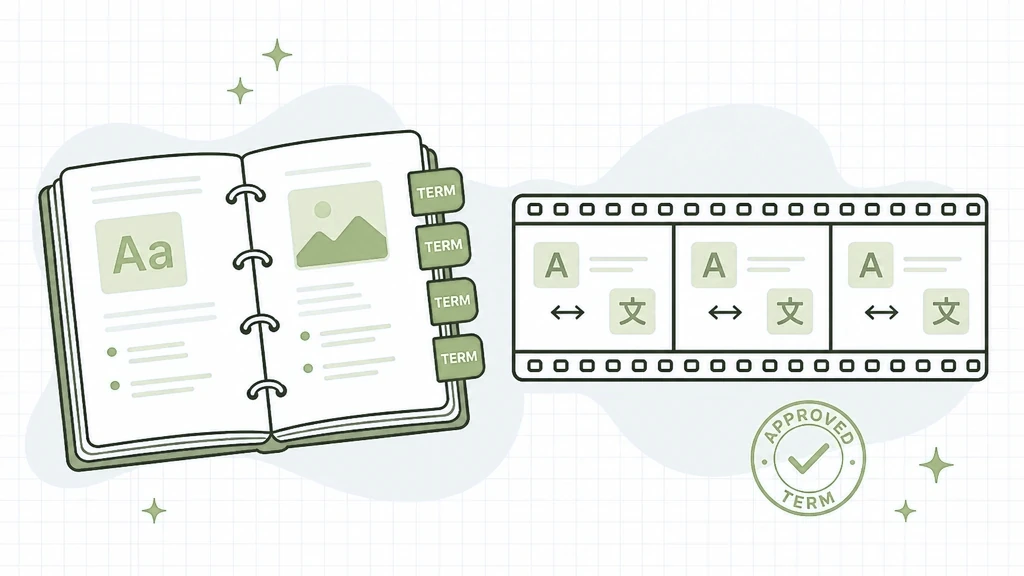
SEO and localization teams often share a goal: publish language versions that users trust and search engines can interpret. Glossaries and translation memory (TM) are the operational layer that keeps terminology consistent while you scale. Without them, the same product might appear under three different names in French, hreflang clusters stay technically valid, and the on-page language signal still weakens because visible copy drifts.
This guide explains what glossaries and TM do, how terminology drift hurts multilingual SEO, and how to govern both without freezing outdated copy or blocking MTPE workflows.
На какие вопросы отвечает это руководство
- What is a translation glossary and how does it differ from TM?
- How do inconsistent terms hurt multilingual SEO and entities?
- Which terms belong in a glossary for website programs?
- How should TM reuse support scale without freezing outdated copy?
- How do glossary rules interact with MTPE workflows?
- How should SEO keyword variants be handled across languages?
- What governance model keeps glossary and TM current?
- How do glossary/TM features show up in translation platforms?
Quick answer: consistency compounds across locales
Quick answer: A translation glossary defines approved terms, brand language and SEO-sensitive vocabulary per locale. Translation memory stores previously translated segments for reuse. Glossaries enforce what to say; TM accelerates how fast you say it consistently. Together they protect entity clarity across crawlable language URLs—especially when Google determines page language from visible content, not from hreflang or lang attributes alone.
Consistency compounds: one inconsistent product name across ten locale URLs creates ten slightly different entity signals. Google recommends distinct crawlable URLs per language version; your terminology systems make each URL read as a coherent language experience rather than a mixed-language template.
Glossary vs translation memory
A translation glossary (terminology database) is a curated list of source terms with approved target-language equivalents, usage notes, and often “do not translate” rules for brand names. Glossaries are prescriptive: they tell translators, reviewers and machine translation engines which word to use for “workspace,” “plan,” or a regulated claim.
Translation memory is a bilingual database of previously translated sentence or segment pairs. When new content resembles past work, TM suggests matches—exact or fuzzy—for reuse. TM is descriptive history: it reflects what was approved before, not necessarily what marketing wants tomorrow.
| System | Primary job | SEO relevance |
|---|---|---|
| Glossary | Lock brand, product and compliance terms | Stable entity labels in titles, H1s, nav and body |
| TM | Reuse vetted phrasing at scale | Faster publishing without reinventing terminology each sprint |
They solve different problems. A glossary without TM still leaves writers free to paraphrase around approved terms. TM without a glossary reuses whatever was translated last quarter—including outdated product names. Mature website programs use both, connected to the same CMS or translation platform.
SEO impact of terminology drift
How do inconsistent terms hurt multilingual SEO and entities?
Google determines page language primarily from visible content. Language versions should keep content and navigation predominantly in one language. When the same concept appears under multiple labels—“multilingual SEO platform” on one page and a different product descriptor on another—users and search systems receive a noisier topical signal.
Terminology drift also creates mixed-language experiences: English product names left untranslated in otherwise Spanish navigation, or half-localized UI strings beside fully localized body copy. Google helpful-content guidance prioritizes people-first pages; thin or boilerplate-only language versions are weak SEO and weak answer sources. Consistent, people-first language versions help users and search systems understand topical clarity.
Hreflang annotations tell Google about alternate language or regional URLs and must be reciprocal across the set of pages they describe—but hreflang does not fix confusing on-page language. Each language version should remain predominantly in one language, including navigation and core product terminology users expect.
Bing Webmaster Guidelines similarly emphasize crawlable, useful content and clear site structure for indexing across markets. Terminology consistency supports that clarity; it is not a documented ranking factor by itself.
What to put in a website glossary
Which terms belong in a glossary for website programs?
Start with terms that appear in high-visibility, high-risk surfaces:
- Brand and product names (translate, transliterate, or protect)
- Plan and feature names referenced in titles, meta descriptions and H1s
- Category and navigation labels repeated across templates
- Compliance and legal phrases where variation creates risk
- SEO keyword targets agreed per locale—not literal English exports, but approved local equivalents tied to research
- UI microcopy in headers, buttons and empty states
- Integration and partner names with official spellings
For each entry, document: source term, approved translation, forbidden alternatives, part of speech, context note (“use on pricing pages only”), and owner. Link glossary entries to URL patterns when terminology differs by section (marketing site vs docs).
Avoid bloating the glossary with every common word. Focus on terms whose variation would confuse users or split entity recognition across locales.
TM reuse without stale copy
How should TM reuse support scale without freezing outdated copy?
TM is powerful for repetitive website content: footers, feature blurbs, security statements, and help snippets. It becomes a liability when product marketing rebrands but TM keeps serving old matches at high fuzzy-match scores.
Practical controls:
- Segment aging — flag TM units older than a release cycle for revalidation
- Match thresholds — require human review for fuzzy matches on glossary-controlled terms
- Source updates — when English source changes materially, deprecate affected TM units instead of auto-propagating
- Glossary precedence — glossary hits override TM suggestions when they conflict
- Version tags — tie TM batches to product versions or content pillars
- Periodic TM pruning — archive segments tied to retired pages or deprecated features
The goal is speed with guardrails, not maximum reuse at any quality cost. Google does not rank TM usage; users and crawlers respond to whether the published language version still reads as helpful and current.
Keyword variants across languages
How should SEO keyword variants be handled across languages?
Do not treat English keyword lists as direct translation input. Approved local keyword variants belong in the glossary as preferred renderings when they reflect in-market research—not as forced insertions into every sentence.
Workflow:
- Research demand in the target language and market (see dedicated international keyword research guidance).
- Agree primary and secondary phrasing per locale with SEO and localization owners.
- Add approved variants to the glossary with usage context (“title/H1 acceptable,” “body only,” “avoid in legal copy”).
- Train MT and MTPE reviewers to respect glossary SEO entries as hard constraints where marked
- Revisit after launch using Search Console queries per property or directory
Each language or locale URL should have a clear canonical that prefers the same-language preferred URL when duplicates exist. Keyword alignment across locales supports that clarity; keyword stuffing does not.
MTPE and glossary enforcement
How do glossary rules interact with MTPE workflows?
Machine translation post-editing (MTPE) sits between raw MT and human translation. Glossaries should feed the MT engine before post-editing begins so reviewers fix style and flow—not basic terminology errors repeatedly.
In MTPE workflows:
- Pre-MT: apply glossary to the engine and lock “do not translate” entries
- During edit: highlight glossary violations in the CAT or TMS UI
- QA pass: automated glossary checks before publish
- Feedback loop: editors propose glossary updates when MTPE surfaces systematic gaps
Glossary enforcement is especially important on pages Google must read as predominantly one language. Mixed-language segments from inconsistent MTPE erode the visible-language signal even when hreflang and sitemaps are correct.
Governance and ownership
What governance model keeps glossary and TM current?
Assign clear owners:
| Asset | Typical owner | Периодичность |
|---|---|---|
| Glossary | Localization lead + SEO + legal | Monthly review; ad hoc on launches |
| TM | Localization ops | Quarterly prune; immediate on rebrand |
| SEO keyword entries | SEO lead per region | After research cycles and GSC reviews |
Run a lightweight change process: propose → review (SEO + legal if needed) → publish to TMS → notify vendors. Track glossary version in release notes so engineers know which TM/glossary snapshot shipped.
Connect governance to site architecture: when you add crawlable URLs for new languages, confirm XML sitemaps help discovery of language versions and can carry hreflang annotations when used as an implementation method. Terminology work lands last-mile on those URLs.
Список задач по внедрению
Use this checklist when standing up or auditing glossary and TM for SEO:
How glossary and TM features show up in translation platforms
How do glossary/TM features show up in translation platforms? In practice, you should expect four integration points:
- Authoring and CMS export — source pages export translatable segments with stable IDs so TM can match reliably across releases.
- TMS or localization hub — glossaries and TM databases live centrally; vendors and in-house linguists share one truth.
- MT engine connectors — glossaries push terminology constraints before MT or MTPE; TM pre-fills known segments.
- Publish-back — approved target strings return to the CMS with locale metadata for crawlable URLs.
Platforms differ in UI details, but the workflow pattern is consistent: glossary entries surface as mandatory substitutions, TM matches appear as suggested segments with match scores, and QA reports flag violations before publish. SEO teams should ask whether glossary terms can be tagged by surface (title, meta, H1, body) and whether TM match thresholds are configurable per content type.
When evaluating tools, confirm that glossary updates propagate without stale TM silently overriding them, and that locale-specific SEO keyword entries can be enforced separately from generic terminology. Without those controls, platforms become faster ways to publish inconsistent language versions.
Traditional search foundations for language versions
Google recommends distinct crawlable URLs per language version rather than cookie-based switching. Terminology systems support that architecture by ensuring each URL reads as a complete language experience—navigation, body, and metadata aligned. Hreflang annotations tell Google about alternate language or regional URLs and must be reciprocal; glossary discipline makes each alternate worth serving because the language signal is coherent.
Each language or locale URL should have a clear canonical that prefers the same-language preferred URL when duplicates exist. When regional variants share language but differ in product names or offers, glossaries document which terms stay global versus market-specific—preventing accidental canonical collisions from terminology drift.
Working with vendors and in-house linguists
Publish a glossary handbook alongside TM guidelines: when to accept fuzzy matches, when to escalate brand terms, and how to propose new entries. Vendor turnover is a common hidden cause of terminology drift; centralized glossaries reduce re-training cost.
Run spot audits on live locale URLs after each release train. Sample five templates per language and check whether titles, nav labels, and repeated feature names match glossary entries. Mismatch patterns often reveal TM segments that need deprecation or glossary gaps that MTPE exposed but nobody recorded.
Consistent terminology also supports internal linking across locales: when product names match glossary entries, anchor text variants resolve to the same conceptual entity in each language—helping users navigate and helping search systems relate alternate URLs in a hreflang set without contradictory labels.
Основы традиционного поиска и answer engines
Shared foundations for glossary and TM consistency across language versions still matter across Google, Bing, and answer engines: crawlable language versions, clear entities, evidence-backed claims, structured data where truthful, and real localization—not English-only shells. Treat the guides below as platform-specific lenses on the same multilingual delivery bar.
Руководство по платформе: Google Search
В поиске Google страницы обнаруживаются благодаря доступным для сканирования URL локалей с HTML на нужном языке, точными заголовками и подзаголовками, а также взаимными hreflang-аннотациями, если есть альтернативные версии. Техническая основа включает индексируемый контент (а не переключение только по cookie), локализованные метаданные, карты сайта и корректную настройку canonical. Качественный контент — это полезные для людей материалы на каждом языке; авторитетность обеспечивают понятная информация об организации и подтверждающие источники, а не маркетинговые заявления о переводческих инструментах. Для работы с несколькими языками каждая страница рынка или языка должна быть самостоятельной. Отслеживайте индексирование в Search Console и проверяйте URL каждой локали. Что известно и что не подтверждено: Google описывает работу многоязычных страниц и hreflang, но не гарантирует высоких позиций при использовании какой-либо CMS или процесса MTPE.
Руководство по платформе: Bing
Bing обнаруживает и индексирует доступные для сканирования многоязычные страницы с чёткой структурой; в этом он, как и Google, ориентируется на понятные URL и содержание. К техническим основам относятся доступные для загрузки URL локалей, полезный контент и мониторинг в Bing Webmaster Tools. Вместо перевода только элементов интерфейса локализуйте заголовки, утверждения и разделы FAQ. Авторитетность по-прежнему зависит от надёжных источников и последовательного представления сущностей. Для многоязычных сайтов это означает, что языки нельзя скрывать за переключателями, работающими только на стороне клиента. Отслеживайте индексацию и статистику сканирования в Bing Webmaster Tools. Что известно, а что нет: рекомендации Bing подчёркивают важность доступного для сканирования полезного контента; не приписывайте инструментам перевода особые факторы ранжирования в Bing.
Руководство по платформе: ChatGPT
ChatGPT может цитировать или кратко пересказывать общедоступные страницы, если языковые версии легко различить и они содержат готовые ответы. Это не обычное ранжирование по результатам сканирования: видимость означает, что страницу выбрали в качестве источника или упомянули в ответе. Техническая основа по-прежнему начинается с доступных HTML-страниц, а не с наложенных поверх них виджетов, скрывающих текст. Полезны прямые ответы, разделы с часто задаваемыми вопросами и единообразная терминология из глоссариев. Авторитетность обеспечивают подтверждённые данные и единообразные сущности во всех локалях. Для многоязычного сайта каждая страница локали должна быть понятна сама по себе. Результаты сложно измерить точно — воспринимайте проверки цитирования как гипотезы. Что известно и что не подтверждено: нет документированных гарантий, что MTPE или интеграция с какой-либо CMS обеспечит цитирование в ChatGPT.
Руководство по платформе: Gemini
Gemini и связанные с ним возможности Google на базе ИИ лучше работают, когда сущности описаны согласованно, структурированные данные используются там, где это уместно, а локализованные страницы доступны для индексации. Видимость означает, что на страницу ссылаются или её распознают, а не то, что нужно выдумывать факторы ранжирования Gemini. Технические основы во многом совпадают с требованиями Google Поиска к доступности страниц для сканирования и качеству метаданных. Контент на каждом языке должен содержать чёткие утверждения и определения. Авторитетность зависит от последовательности в представлении организации и подтверждения информации из других источников. Для многоязычных сайтов это означает, что единый глоссарий названий продуктов помогает избежать путаницы в разных языковых версиях. Эффективность можно оценивать традиционными средствами, например в Search Console, а ответы ИИ — выборочно анализировать вручную. Что известно, а что нет: поведение Gemini не заменяет документированные рекомендации Google Поиска по hreflang и языковым версиям.
Руководство по платформе: Обзоры от Google на базе ИИ
В Обзорах от Google на базе ИИ могут появляться ссылки на страницы с подтверждающей информацией; при этом право на показ по-прежнему зависит от наличия полезного для людей контента, доступного для индексации. Обзоры не переключают язык и не заменяют hreflang. Техническая основа остаётся прежней: HTML-страницы для каждого языка и региона должны быть доступны для сканирования, а структурированные данные — достоверны. Качественный контент на каждом языке даёт краткие ответы и использует понятные заголовки. Сигналы авторитетности соответствуют требованиям к полезному контенту. Для многоязычных сайтов это означает, что показ в Обзорах не гарантирован ни для одной переведённой страницы. Если доступны отчёты о генеративном поиске в Search Console, используйте их для оценки результатов, отдельно отслеживая традиционные показатели индексации. Что известно, а что нет: ни один процесс перевода не может гарантировать появление страницы в Обзорах.
Какую роль играет GlotEO
Glossary and TM discipline is easier when terminology rules, translation memory and publishing workflows live in one multilingual SEO platform—not scattered across spreadsheets and ad hoc CAT exports.
GlotEO glossary control for translations helps teams enforce approved terms while translation memory for website localization accelerates reuse without bypassing governance. Pair those features with website localization workflows when you are scaling language versions beyond a handful of pages.
For the strategic split between language and country targeting, see how international SEO differs from multilingual SEO. When you are ready to compare capabilities and limits, review GlotEO pricing and plans.
Explore GlotEO website localization to connect terminology governance with crawlable, people-first language versions across your site.
Источники
- Подтверждает рекомендации, приведённые в этой статье (Рекомендации для веб-мастеров Bing)
- Подтверждает рекомендации, приведённые в этой статье (Как указать канонический URL с помощью rel=canonical и других методов)
- Подтверждает рекомендации, приведённые в этой статье (Создание полезного и надёжного контента, ориентированного на людей)
- Подтверждает рекомендации, приведённые в этой статье (Как сообщить Google о локализованных версиях страницы)
- Подтверждает рекомендации, приведённые в этой статье (Управление многоязычными и мультирегиональными сайтами)
- Рекомендации, упомянутые в этой статье (Подробнее о файлах Sitemap)