


Cum să traduceți un site Webflow pentru SEO multilingv
Planificați URL-urile Webflow pentru fiecare limbă, câmpurile SEO localizate, alinierea CMS-ului, hreflang și fluxurile de QA, astfel încât fiecare versiune lingvistică să poată fi indexată și să răspundă nevoilor oamenilor.
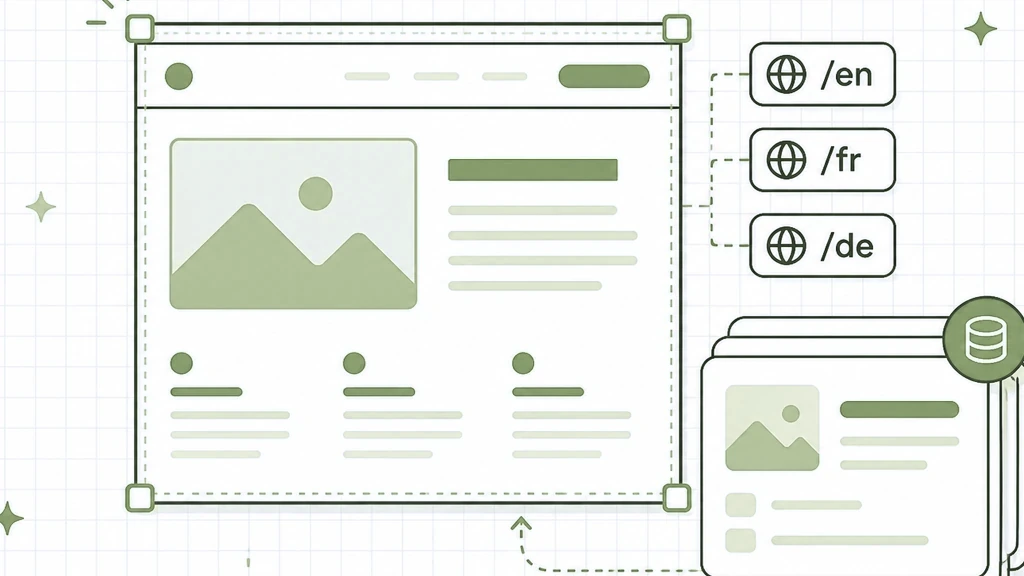
Translating a Webflow site is not only a design or CMS task—it is an international SEO architecture decision. Webflow teams often start with a language switcher widget or a third-party overlay, then discover that Google cannot reliably crawl distinct language versions, metadata stays in English, or hreflang clusters break when CMS collections drift.
This guide walks Webflow marketers and freelancers through a crawlable locale plan grounded in Google’s multilingual documentation: distinct URLs per language, localized SEO fields, CMS alignment, hreflang and sitemaps, native versus third-party translation approaches, and a review workflow that prevents mixed-language pages. No ranking guarantees—only practices Google and Bing document for discoverable language versions.
Quick answer: localize Webflow pages on distinct URLs
Short answer: Publish each Webflow language version on its own crawlable URL with localized primary content, navigation, and metadata—not on cookie-only or browser-language switches alone.
Google recommends different URLs for each language or region version rather than relying on cookies or browser settings alone. For Webflow, that usually means subdirectories such as /fr/ or /de-de/, locale-specific CMS items, and a visible language selector that links to those URLs. Pre-rendered pages in Webflow’s publish pipeline help crawlers see the same HTML users see.
Avoid auto-redirecting visitors based on guessed language or location. Google advises against automatic redirects and recommends a user-visible language or country selector instead. Let users choose; let crawlers follow links.
Webflow URL and locale planning
Before you translate a single string, decide how locales map to URLs. Common Webflow patterns:
- Subdirectory locales (
example.com/fr/about) on one site—often the simplest for freelancers and marketing teams. - Subdomain locales (
fr.example.com) when legal or analytics separation matters. - Separate Webflow sites per major market when design systems diverge significantly.
Whatever pattern you choose, each language version needs a stable, linkable URL that appears in navigation and sitemaps. Google determines page language primarily from visible content; keep each URL predominantly in one language for both body copy and navigation.
Document a locale matrix early: source page → locale URL → CMS item ID → hreflang code. When you add French, you should know exactly which English pages have French alternates and which are intentionally single-language.
Pair URL planning with international SEO versus multilingual SEO strategy so language and country targeting stay aligned with business goals.
SEO title, meta and Open Graph per locale
Webflow exposes page-level SEO settings: title tag, meta description, Open Graph title and description, and often Twitter cards. Localize all of these per locale URL, not just the visible H1.
Localized SEO titles and meta descriptions should be unique per locale URL rather than shared English metadata across languages. A French product page with an English <title> sends mixed signals to Google and weakens click-through in French SERPs.
Checklist for each localized Webflow page:
- Title tag — written for local query intent, not word-for-word English paste.
- Meta description — unique, human-readable summary in the target language.
- Open Graph / social — localized preview text and images where markets differ.
- Slug — consider localized slugs when they help users; keep redirects if you change them later.
- Canonical — each locale URL should canonical to itself unless you deliberately consolidate duplicates.
Google helpful-content guidance prioritizes people-first pages; thin or boilerplate-only language versions are weak SEO and weak answer sources. Metadata localization is necessary but not sufficient—you still need substantive body content.
CMS collections and shared design systems
Webflow CMS powers blogs, case studies, team pages, and product catalogs. Multilingual CMS work fails when collections fall out of sync: three French posts link to English case studies, or a shared reference field points at the wrong locale item.
Practical alignment strategies:
- Mirror collection structure per locale (separate items per language) with a shared internal ID or reference field linking equivalents.
- Field-level localization when Webflow localization features or integrations support locale-specific fields on one item.
- Shared components, localized content — keep design system classes consistent; swap text, images, and links per locale.
When a CMS template renders mixed languages—English author bio on a German article—Google sees a page that does not match user expectations. Audit collection templates for chrome strings, empty states, and filter labels.
Hreflang, canonicals and sitemaps
Hreflang annotations tell Google about alternate language or regional URLs and must be reciprocal across the set of pages they describe. On Webflow, implement hreflang via:
- Custom code in site or page
<head>(often generated from your locale matrix), - HTTP headers at the hosting edge if your stack supports it, or
- XML sitemaps with
xhtml:linkalternates.
XML sitemaps help discovery of language versions and can carry xhtml:link hreflang annotations when used as an implementation method. Submit updated sitemaps after locale launches.
Each language or locale URL should have a clear canonical that prefers the same-language preferred URL when duplicates exist. Do not point every locale’s canonical at the English homepage while also publishing fully localized pages—you will confuse consolidation signals.
Pick one primary hreflang method and regenerate the full reciprocal set whenever you add or remove a locale. Manual one-off tags on a handful of pages break clusters quickly.
For deeper hreflang mechanics, see your multilingual SEO product capabilities alongside Google’s localized-versions documentation.
Native vs third-party translation approaches
Webflow teams typically choose among:
Native Webflow localization (when available on your plan) — locale fields, localized publishing, and URLs inside the Webflow ecosystem. Pros: stays close to designer workflows. Cons: still requires editorial QA and SEO field discipline.
Third-party translation overlays — JavaScript layers that swap text client-side. Pros: fast-looking launches. Cons: often weaker for crawlability if distinct URLs and server-rendered HTML are missing—Google recommends crawlable URLs, not cookie-only delivery.
Export / TMS / re-import workflows — translate in a CAT tool or platform, then publish localized CMS items. Pros: scales with glossaries and translation memory. Cons: needs process to prevent stale English fallbacks.
There is no universal winner. Evaluate based on whether each approach produces distinct crawlable URLs, localized metadata, and maintainable hreflang—not on demo speed alone.
Editorial workflow and QA
Mixed-language pages usually come from process gaps, not platform bugs. A practical Webflow QA workflow:
- Locale completeness gate — no publish if required fields are empty in the target locale.
- Language spot check — navigation, buttons, form labels, and error messages match the page language.
- Link audit — internal links stay inside the same locale unless intentionally cross-language.
- SEO field review — title, meta, OG localized.
- Hreflang reciprocity sample — test five URL pairs after each locale batch.
- Staging crawl — fetch rendered HTML; confirm language and annotations.
Assign an owner for the locale matrix. Designers should not be the only people who know which pages exist in German.
Listă de verificare pentru implementare
Use this launch list for each new Webflow locale:
Greșeli frecvente
These Webflow translation mistakes hurt SEO most often:
- Cookie or browser-language only — no crawlable alternate URLs.
- English metadata on localized pages — titles and descriptions never translated.
- Boilerplate-only translation — nav in French, body still English.
- Broken hreflang reciprocity — new locale added on some templates only.
- Auto-redirect by IP — blocks users and crawlers from alternates.
- CMS reference drift — localized posts linking to English assets.
- Thin locale stubs — placeholder pages published to “claim” a market.
- Duplicate overlays plus native locales — two systems fighting for the same URLs.
Bing Webmaster Guidelines also emphasize crawlable, useful content and clear site structure for indexing across markets—many of the same crawlability rules apply outside Google.
Bazele căutării tradiționale și ale motoarelor de răspuns
Shared foundations for Webflow locale pages with localized SEO fields still matter across Google, Bing, and answer engines: crawlable language versions, clear entities, evidence-backed claims, structured data where truthful, and real localization—not English-only shells. Treat the guides below as platform-specific lenses on the same multilingual delivery bar.
Ghidul platformei: Google Search
În Google Search, descoperirea depinde de URL-uri localizate accesibile crawlerelor, cu HTML adaptat limbii, titluri și subtitluri corecte și hreflang-uri reciproce atunci când există versiuni alternative. Fundamentele tehnice includ conținut indexabil (nu doar comutatoare bazate pe cookie-uri), metadate localizate, sitemap-uri și folosirea corectă a adreselor canonice. Calitatea conținutului presupune conținut principal destinat oamenilor, în fiecare limbă; autoritatea se construiește printr-o identitate clară a organizației și surse care o confirmă — nu prin promovarea unor instrumente de traducere. Implicație pentru site-urile multilingve: fiecare URL destinat unei piețe sau limbi trebuie să poată funcționa autonom. Măsurați rezultatele folosind rapoartele de acoperire din Search Console și inspecția URL-urilor pentru fiecare limbă. Ce știm și ce nu știm: Google documentează comportamentul versiunilor multilingve și al hreflang-urilor, dar nu garantează poziții mai bune în urma folosirii unui anumit CMS sau flux MTPE.
Ghidul platformei: Bing
Bing descoperă și indexează paginile multilingve accesibile cu crawlere, cu o structură clară, în acord cu așteptările similare ale Google privind claritatea URL-urilor și a conținutului. Bazele tehnice includ URL-uri localizate care pot fi accesate, conținut util și monitorizare în Bing Webmaster Tools. Preferați titluri, afirmații și întrebări frecvente localizate în locul unei traduceri limitate la elementele de interfață. Semnalele de autoritate depind în continuare de surse de încredere și de entități consecvente. Implicație pentru conținutul multilingv: nu ascundeți limbile în spatele unor comutatoare care funcționează doar pe partea clientului. Măsurați indexarea și statisticile de crawlare în Bing Webmaster Tools. Ce se știe și ce rămâne incert: recomandările Bing pun accentul pe conținut util, accesibil cu crawlere; nu inventați factori de poziționare specifici Bing pentru instrumentele de traducere.
Ghidul platformei: ChatGPT
ChatGPT poate cita sau rezuma pagini accesibile publicului atunci când versiunile lingvistice sunt clare și oferă răspunsuri ușor de preluat. Descoperirea nu funcționează ca o clasare convențională în rezultatele crawlerelor; vizibilitatea se manifestă prin selectarea paginii ca sursă sau prin menționarea ei în răspunsuri. Fundamentele tehnice încep tot cu URL-uri HTML accesibile, nu cu suprapuneri de widgeturi care ascund textul. Printre calitățile utile ale conținutului se numără răspunsurile directe, întrebările frecvente și terminologia consecventă din glosare. Autoritatea se bazează pe dovezi și pe entități consecvente în toate versiunile lingvistice. Implicație pentru site-urile multilingve: fiecare pagină localizată ar trebui să poată fi citită și înțeleasă independent. Măsurarea nu este perfectă — considerați verificările citărilor drept ipoteze. Ce știm și ce nu știm: nu există nicio garanție documentată că MTPE sau integrarea unui anumit CMS va duce la citări în ChatGPT.
Ghidul platformei: Gemini
Gemini și experiențele Google AI asociate beneficiază de entități coerente, date structurate atunci când sunt corecte și pagini localizate care pot fi indexate. Vizibilitatea înseamnă să fii menționat sau recunoscut — nu să inventezi factori de poziționare pentru Gemini. Bazele tehnice se suprapun peste cerințele Google Search privind accesul cu crawlere și calitatea metadatelor. Conținutul trebuie să prezinte afirmații și definiții clare în fiecare limbă. Autoritatea depinde de consecvența organizației și de surse care îi confirmă informațiile. Implicație pentru conținutul multilingv: denumirile produselor controlate prin glosar reduc confuziile între localizări. Măsurați în mod tradițional prin Search Console și evaluați calitativ răspunsuri AI selectate. Ce se știe și ce rămâne incert: comportamentul Gemini nu înlocuiește recomandările documentate de Google Search privind hreflang și versiunile lingvistice.
Ghidul platformei: Google AI Overviews
Google AI Overviews poate include linkuri către pagini relevante; criteriile de eligibilitate se bazează în continuare pe conținut accesibil cu crawlere, conceput pentru oameni. AI Overviews nu schimbă limba paginii și nu înlocuiește hreflang. Bazele tehnice rămân paginile HTML localizate, accesibile cu crawlere, și datele structurate corecte. Printre calitățile utile ale conținutului se numără răspunsurile concise și subtitlurile clare în fiecare limbă. Semnalele de autoritate reflectă așteptările privind conținutul util. Implicație pentru conținutul multilingv: includerea unei pagini în Overview nu este garantată pentru nicio pagină tradusă. Măsurați prin rapoartele generative din Search Console, dacă sunt disponibile, și separați-le de indicatorii tradiționali de indexare. Ce se știe și ce rămâne incert: niciun flux de traducere nu poate garanta apariția în Overview.
Cum se integrează GlotEO
Webflow localization succeeds when design, CMS, and SEO ops share one source of truth for locales. GlotEO Webflow translation integration helps teams manage website localization workflows—linking briefs, glossaries, and review steps—while you keep Webflow’s visual stack and crawlable URL architecture intact.
If you are scaling beyond a handful of manual page copies, explore the website localization platform to coordinate translation, QA, and publish gates without losing SEO signals. Review GlotEO pricing and plans when you are ready to compare workflow tiers.
Pair this implementation guide with international SEO versus multilingual SEO for strategy context, and use multilingual SEO tooling when hreflang and metadata governance become part of everyday editorial work.
Surse
- Susține recomandările citate în acest articol (Instrucțiunile Bing pentru webmasteri)
- Susține recomandările citate în acest articol (Cum se specifică un URL canonic folosind rel=canonical și alte metode)
- Susține recomandările citate în acest articol (Crearea de conținut util și de încredere, centrat pe oameni)
- Susține recomandările citate în acest articol (Informează Google despre versiunile localizate ale paginii tale)
- Susține recomandările citate în acest articol (Gestionarea site-urilor cu mai multe regiuni și limbi)
- Susține recomandările menționate în acest articol (Aflați despre sitemapuri)