



Como traduzir um site Webflow para SEO multilíngue
Planeje URLs por localidade no Webflow, campos de SEO localizados, alinhamento do CMS, hreflang e fluxos de controle de qualidade para que cada versão de idioma seja rastreável e voltada às pessoas.
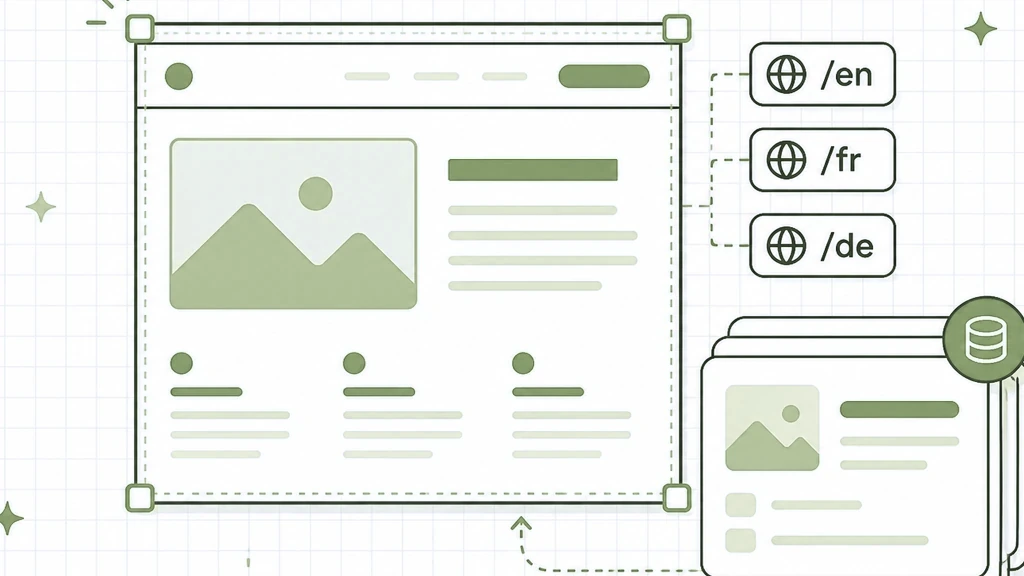
Translating a Webflow site is not only a design or CMS task—it is an international SEO architecture decision. Webflow teams often start with a language switcher widget or a third-party overlay, then discover that Google cannot reliably crawl distinct language versions, metadata stays in English, or hreflang clusters break when CMS collections drift.
This guide walks Webflow marketers and freelancers through a crawlable locale plan grounded in Google’s multilingual documentation: distinct URLs per language, localized SEO fields, CMS alignment, hreflang and sitemaps, native versus third-party translation approaches, and a review workflow that prevents mixed-language pages. No ranking guarantees—only practices Google and Bing document for discoverable language versions.
Quick answer: localize Webflow pages on distinct URLs
Short answer: Publish each Webflow language version on its own crawlable URL with localized primary content, navigation, and metadata—not on cookie-only or browser-language switches alone.
Google recommends different URLs for each language or region version rather than relying on cookies or browser settings alone. For Webflow, that usually means subdirectories such as /fr/ or /de-de/, locale-specific CMS items, and a visible language selector that links to those URLs. Pre-rendered pages in Webflow’s publish pipeline help crawlers see the same HTML users see.
Avoid auto-redirecting visitors based on guessed language or location. Google advises against automatic redirects and recommends a user-visible language or country selector instead. Let users choose; let crawlers follow links.
Webflow URL and locale planning
Before you translate a single string, decide how locales map to URLs. Common Webflow patterns:
- Subdirectory locales (
example.com/fr/about) on one site—often the simplest for freelancers and marketing teams. - Subdomain locales (
fr.example.com) when legal or analytics separation matters. - Separate Webflow sites per major market when design systems diverge significantly.
Whatever pattern you choose, each language version needs a stable, linkable URL that appears in navigation and sitemaps. Google determines page language primarily from visible content; keep each URL predominantly in one language for both body copy and navigation.
Document a locale matrix early: source page → locale URL → CMS item ID → hreflang code. When you add French, you should know exactly which English pages have French alternates and which are intentionally single-language.
Pair URL planning with international SEO versus multilingual SEO strategy so language and country targeting stay aligned with business goals.
SEO title, meta and Open Graph per locale
Webflow exposes page-level SEO settings: title tag, meta description, Open Graph title and description, and often Twitter cards. Localize all of these per locale URL, not just the visible H1.
Localized SEO titles and meta descriptions should be unique per locale URL rather than shared English metadata across languages. A French product page with an English <title> sends mixed signals to Google and weakens click-through in French SERPs.
Checklist for each localized Webflow page:
- Title tag — written for local query intent, not word-for-word English paste.
- Meta description — unique, human-readable summary in the target language.
- Open Graph / social — localized preview text and images where markets differ.
- Slug — consider localized slugs when they help users; keep redirects if you change them later.
- Canonical — each locale URL should canonical to itself unless you deliberately consolidate duplicates.
Google helpful-content guidance prioritizes people-first pages; thin or boilerplate-only language versions are weak SEO and weak answer sources. Metadata localization is necessary but not sufficient—you still need substantive body content.
CMS collections and shared design systems
Webflow CMS powers blogs, case studies, team pages, and product catalogs. Multilingual CMS work fails when collections fall out of sync: three French posts link to English case studies, or a shared reference field points at the wrong locale item.
Practical alignment strategies:
- Mirror collection structure per locale (separate items per language) with a shared internal ID or reference field linking equivalents.
- Field-level localization when Webflow localization features or integrations support locale-specific fields on one item.
- Shared components, localized content — keep design system classes consistent; swap text, images, and links per locale.
When a CMS template renders mixed languages—English author bio on a German article—Google sees a page that does not match user expectations. Audit collection templates for chrome strings, empty states, and filter labels.
Hreflang, URLs canônicas e sitemaps
Hreflang annotations tell Google about alternate language or regional URLs and must be reciprocal across the set of pages they describe. On Webflow, implement hreflang via:
- Custom code in site or page
<head>(often generated from your locale matrix), - HTTP headers at the hosting edge if your stack supports it, or
- XML sitemaps with
xhtml:linkalternates.
XML sitemaps help discovery of language versions and can carry xhtml:link hreflang annotations when used as an implementation method. Submit updated sitemaps after locale launches.
Each language or locale URL should have a clear canonical that prefers the same-language preferred URL when duplicates exist. Do not point every locale’s canonical at the English homepage while also publishing fully localized pages—you will confuse consolidation signals.
Pick one primary hreflang method and regenerate the full reciprocal set whenever you add or remove a locale. Manual one-off tags on a handful of pages break clusters quickly.
For deeper hreflang mechanics, see your multilingual SEO product capabilities alongside Google’s localized-versions documentation.
Native vs third-party translation approaches
Webflow teams typically choose among:
Native Webflow localization (when available on your plan) — locale fields, localized publishing, and URLs inside the Webflow ecosystem. Pros: stays close to designer workflows. Cons: still requires editorial QA and SEO field discipline.
Third-party translation overlays — JavaScript layers that swap text client-side. Pros: fast-looking launches. Cons: often weaker for crawlability if distinct URLs and server-rendered HTML are missing—Google recommends crawlable URLs, not cookie-only delivery.
Export / TMS / re-import workflows — translate in a CAT tool or platform, then publish localized CMS items. Pros: scales with glossaries and translation memory. Cons: needs process to prevent stale English fallbacks.
There is no universal winner. Evaluate based on whether each approach produces distinct crawlable URLs, localized metadata, and maintainable hreflang—not on demo speed alone.
Editorial workflow and QA
Mixed-language pages usually come from process gaps, not platform bugs. A practical Webflow QA workflow:
- Locale completeness gate — no publish if required fields are empty in the target locale.
- Language spot check — navigation, buttons, form labels, and error messages match the page language.
- Link audit — internal links stay inside the same locale unless intentionally cross-language.
- SEO field review — title, meta, OG localized.
- Hreflang reciprocity sample — test five URL pairs after each locale batch.
- Staging crawl — fetch rendered HTML; confirm language and annotations.
Assign an owner for the locale matrix. Designers should not be the only people who know which pages exist in German.
Lista de verificação de implementação
Use this launch list for each new Webflow locale:
Erros comuns
These Webflow translation mistakes hurt SEO most often:
- Cookie or browser-language only — no crawlable alternate URLs.
- English metadata on localized pages — titles and descriptions never translated.
- Boilerplate-only translation — nav in French, body still English.
- Broken hreflang reciprocity — new locale added on some templates only.
- Auto-redirect by IP — blocks users and crawlers from alternates.
- CMS reference drift — localized posts linking to English assets.
- Thin locale stubs — placeholder pages published to “claim” a market.
- Duplicate overlays plus native locales — two systems fighting for the same URLs.
Bing Webmaster Guidelines also emphasize crawlable, useful content and clear site structure for indexing across markets—many of the same crawlability rules apply outside Google.
Fundamentos da busca tradicional e dos mecanismos de respostas
Shared foundations for Webflow locale pages with localized SEO fields still matter across Google, Bing, and answer engines: crawlable language versions, clear entities, evidence-backed claims, structured data where truthful, and real localization—not English-only shells. Treat the guides below as platform-specific lenses on the same multilingual delivery bar.
Guia da plataforma: Pesquisa Google
Na Pesquisa Google, a descoberta depende de URLs de idioma e região rastreáveis, com HTML adequado ao idioma, títulos e cabeçalhos precisos e hreflang recíproco quando houver versões alternativas. Os fundamentos técnicos incluem conteúdo indexável (não apenas seletores baseados em cookies), metadados localizados, sitemaps e rigor na canonicalização. Qualidade de conteúdo significa oferecer conteúdo principal feito para pessoas em cada idioma; a autoridade vem da identidade clara da organização e de fontes que confirmem as informações — não do marketing de ferramentas de tradução. Implicação multilíngue: cada URL de mercado ou idioma deve funcionar de forma independente. Meça os resultados com a cobertura do Search Console e a Inspeção de URL por idioma e região. O que se sabe e o que é incerto: o Google documenta o comportamento multilíngue e do hreflang; não garante posicionamentos com base em nenhum CMS ou fluxo de trabalho de MTPE.
Guia da plataforma: Bing
O Bing descobre e indexa páginas multilíngues rastreáveis com estrutura clara, de forma semelhante às expectativas do Google quanto à clareza de URLs e conteúdo. Os fundamentos técnicos incluem URLs de idioma e região que possam ser acessadas pelos rastreadores, conteúdo útil e monitoramento no Bing Webmaster Tools. Priorize a localização de cabeçalhos, afirmações e perguntas frequentes, em vez de traduzir apenas os elementos da interface. Os sinais de autoridade continuam dependendo de fontes confiáveis e entidades consistentes. Implicação para sites multilíngues: não esconda idiomas atrás de seletores que funcionam apenas no lado do cliente. Meça a indexação e as estatísticas de rastreamento no Bing Webmaster Tools. O que se sabe e o que é incerto: as diretrizes do Bing enfatizam conteúdo útil e rastreável; não invente fatores de classificação exclusivos do Bing para ferramentas de tradução.
Guia da plataforma: ChatGPT
O ChatGPT pode citar ou resumir páginas acessíveis publicamente quando as versões de idioma são claras e estão prontas para fornecer respostas. A descoberta não segue uma classificação convencional de busca por rastreamento; a visibilidade se manifesta na seleção como fonte ou na menção nas respostas. Os fundamentos técnicos ainda começam com URLs HTML acessíveis — não com sobreposições de widgets que ocultam o texto. Entre as qualidades de conteúdo que ajudam estão respostas diretas, perguntas frequentes e terminologia estável baseada em glossários. A autoridade vem de evidências e de entidades consistentes entre versões de idioma e região. Implicação multilíngue: cada página localizada deve ser compreensível por si só. A medição é imperfeita — trate as verificações de citações como hipóteses. O que se sabe e o que é incerto: não há garantia documentada de que a MTPE ou qualquer integração com um CMS gere citações no ChatGPT.
Guia da plataforma: Gemini
O Gemini e as experiências relacionadas de IA do Google se beneficiam de entidades coerentes, dados estruturados precisos e páginas localizadas indexáveis. A visibilidade está ligada a receber referências ou ser reconhecido — não a inventar fatores de classificação do Gemini. Os fundamentos técnicos coincidem com os da Pesquisa Google em relação à rastreabilidade e à qualidade dos metadados. O conteúdo deve apresentar afirmações e definições claras em cada idioma. A autoridade depende da consistência da organização e da confirmação das informações por outras fontes. Implicação para sites multilíngues: nomes de produtos padronizados por um glossário reduzem a confusão entre versões de idioma e região. Faça a medição tradicional pelo Search Console e avalie qualitativamente amostras de respostas da IA. O que se sabe e o que é incerto: o comportamento do Gemini não substitui as orientações documentadas da Pesquisa Google sobre hreflang e versões de idioma.
Guia da plataforma: Google AI Overviews
O Google AI Overviews pode incluir links para páginas de apoio; os critérios de elegibilidade continuam baseados em conteúdo indexável e voltado para as pessoas. Esse recurso não funciona como um seletor de idiomas nem substitui o hreflang. As bases técnicas continuam sendo HTML rastreável para cada localidade e dados estruturados fiéis ao conteúdo. Entre as qualidades do conteúdo estão respostas concisas e títulos claros em cada idioma. Os sinais de autoridade seguem as expectativas para conteúdo útil. Implicação para sites multilíngues: a inclusão no AI Overviews não é garantida para nenhuma página traduzida. Acompanhe os relatórios de recursos generativos no Search Console, quando disponíveis, e mantenha as métricas tradicionais de indexação separadas. O que se sabe e o que permanece incerto: nenhum fluxo de trabalho de tradução pode prometer presença no AI Overviews.
Onde a GlotEO se encaixa
Webflow localization succeeds when design, CMS, and SEO ops share one source of truth for locales. GlotEO Webflow translation integration helps teams manage website localization workflows—linking briefs, glossaries, and review steps—while you keep Webflow’s visual stack and crawlable URL architecture intact.
If you are scaling beyond a handful of manual page copies, explore the website localization platform to coordinate translation, QA, and publish gates without losing SEO signals. Review GlotEO pricing and plans when you are ready to compare workflow tiers.
Pair this implementation guide with international SEO versus multilingual SEO for strategy context, and use multilingual SEO tooling when hreflang and metadata governance become part of everyday editorial work.
Referências
- Fundamenta as orientações citadas neste artigo (Diretrizes do Bing para webmasters)
- Fundamenta as orientações citadas neste artigo (Como especificar uma URL canônica com rel=canonical e outros métodos)
- Fundamenta as orientações citadas neste artigo (Como criar conteúdo útil, confiável e voltado para as pessoas)
- Fundamenta as orientações citadas neste artigo (Informe o Google sobre as versões localizadas da sua página)
- Fundamenta as orientações citadas neste artigo (Gerenciamento de sites multirregionais e multilíngues)
- Fundamenta as orientações citadas neste artigo (Saiba mais sobre sitemaps)