


Jak przetłumaczyć stronę Webflow z myślą o wielojęzycznym SEO
Zaplanuj adresy URL dla wersji językowych w Webflow, lokalizację pól SEO, dopasowanie CMS, hreflang i procesy kontroli jakości, aby każdą wersję językową można było indeksować i by była przyjazna dla użytkowników.
Translating a Webflow site is not only a design or CMS task—it is an international SEO architecture decision. Webflow teams often start with a language switcher widget or a third-party overlay, then discover that Google cannot reliably crawl distinct language versions, metadata stays in English, or hreflang clusters break when CMS collections drift.
This guide walks Webflow marketers and freelancers through a crawlable locale plan grounded in Google’s multilingual documentation: distinct URLs per language, localized SEO fields, CMS alignment, hreflang and sitemaps, native versus third-party translation approaches, and a review workflow that prevents mixed-language pages. No ranking guarantees—only practices Google and Bing document for discoverable language versions.
Quick answer: localize Webflow pages on distinct URLs
Short answer: Publish each Webflow language version on its own crawlable URL with localized primary content, navigation, and metadata—not on cookie-only or browser-language switches alone.
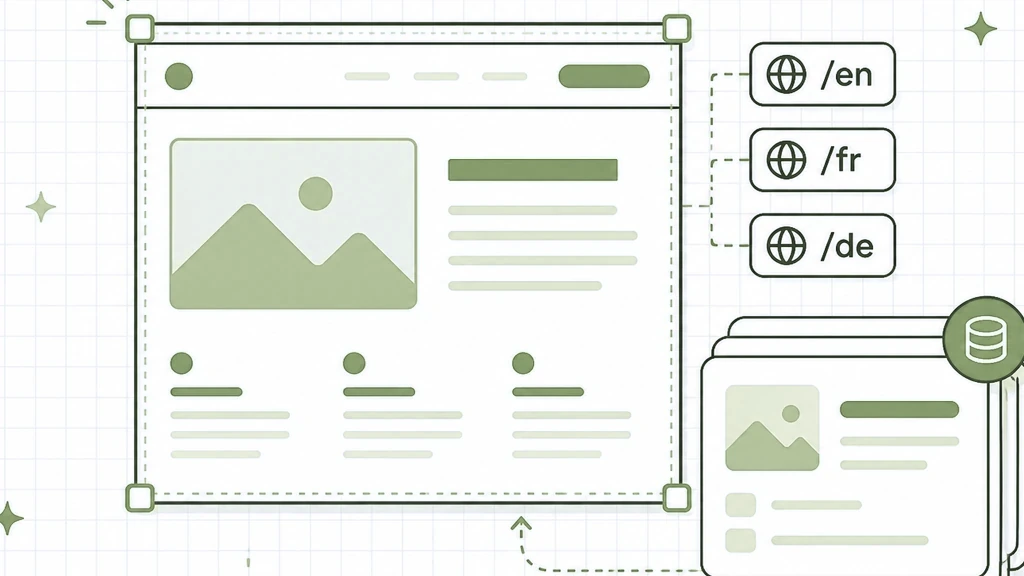
Google recommends different URLs for each language or region version rather than relying on cookies or browser settings alone. For Webflow, that usually means subdirectories such as /fr/ or /de-de/, locale-specific CMS items, and a visible language selector that links to those URLs. Pre-rendered pages in Webflow’s publish pipeline help crawlers see the same HTML users see.
Avoid auto-redirecting visitors based on guessed language or location. Google advises against automatic redirects and recommends a user-visible language or country selector instead. Let users choose; let crawlers follow links.
Webflow URL and locale planning
Before you translate a single string, decide how locales map to URLs. Common Webflow patterns:
- Subdirectory locales (
example.com/fr/about) on one site—often the simplest for freelancers and marketing teams. - Subdomain locales (
fr.example.com) when legal or analytics separation matters. - Separate Webflow sites per major market when design systems diverge significantly.
Whatever pattern you choose, each language version needs a stable, linkable URL that appears in navigation and sitemaps. Google determines page language primarily from visible content; keep each URL predominantly in one language for both body copy and navigation.
Document a locale matrix early: source page → locale URL → CMS item ID → hreflang code. When you add French, you should know exactly which English pages have French alternates and which are intentionally single-language.
Pair URL planning with international SEO versus multilingual SEO strategy so language and country targeting stay aligned with business goals.
SEO title, meta and Open Graph per locale
Webflow exposes page-level SEO settings: title tag, meta description, Open Graph title and description, and often Twitter cards. Localize all of these per locale URL, not just the visible H1.
Localized SEO titles and meta descriptions should be unique per locale URL rather than shared English metadata across languages. A French product page with an English <title> sends mixed signals to Google and weakens click-through in French SERPs.
Checklist for each localized Webflow page:
- Title tag — written for local query intent, not word-for-word English paste.
- Meta description — unique, human-readable summary in the target language.
- Open Graph / social — localized preview text and images where markets differ.
- Slug — consider localized slugs when they help users; keep redirects if you change them later.
- Canonical — each locale URL should canonical to itself unless you deliberately consolidate duplicates.
Google helpful-content guidance prioritizes people-first pages; thin or boilerplate-only language versions are weak SEO and weak answer sources. Metadata localization is necessary but not sufficient—you still need substantive body content.
CMS collections and shared design systems
Webflow CMS powers blogs, case studies, team pages, and product catalogs. Multilingual CMS work fails when collections fall out of sync: three French posts link to English case studies, or a shared reference field points at the wrong locale item.
Practical alignment strategies:
- Mirror collection structure per locale (separate items per language) with a shared internal ID or reference field linking equivalents.
- Field-level localization when Webflow localization features or integrations support locale-specific fields on one item.
- Shared components, localized content — keep design system classes consistent; swap text, images, and links per locale.
When a CMS template renders mixed languages—English author bio on a German article—Google sees a page that does not match user expectations. Audit collection templates for chrome strings, empty states, and filter labels.
Hreflang, adresy kanoniczne i mapy witryn
Hreflang annotations tell Google about alternate language or regional URLs and must be reciprocal across the set of pages they describe. On Webflow, implement hreflang via:
- Custom code in site or page
<head>(often generated from your locale matrix), - HTTP headers at the hosting edge if your stack supports it, or
- XML sitemaps with
xhtml:linkalternates.
XML sitemaps help discovery of language versions and can carry xhtml:link hreflang annotations when used as an implementation method. Submit updated sitemaps after locale launches.
Each language or locale URL should have a clear canonical that prefers the same-language preferred URL when duplicates exist. Do not point every locale’s canonical at the English homepage while also publishing fully localized pages—you will confuse consolidation signals.
Pick one primary hreflang method and regenerate the full reciprocal set whenever you add or remove a locale. Manual one-off tags on a handful of pages break clusters quickly.
For deeper hreflang mechanics, see your multilingual SEO product capabilities alongside Google’s localized-versions documentation.
Native vs third-party translation approaches
Webflow teams typically choose among:
Native Webflow localization (when available on your plan) — locale fields, localized publishing, and URLs inside the Webflow ecosystem. Pros: stays close to designer workflows. Cons: still requires editorial QA and SEO field discipline.
Third-party translation overlays — JavaScript layers that swap text client-side. Pros: fast-looking launches. Cons: often weaker for crawlability if distinct URLs and server-rendered HTML are missing—Google recommends crawlable URLs, not cookie-only delivery.
Export / TMS / re-import workflows — translate in a CAT tool or platform, then publish localized CMS items. Pros: scales with glossaries and translation memory. Cons: needs process to prevent stale English fallbacks.
There is no universal winner. Evaluate based on whether each approach produces distinct crawlable URLs, localized metadata, and maintainable hreflang—not on demo speed alone.
Editorial workflow and QA
Mixed-language pages usually come from process gaps, not platform bugs. A practical Webflow QA workflow:
- Locale completeness gate — no publish if required fields are empty in the target locale.
- Language spot check — navigation, buttons, form labels, and error messages match the page language.
- Link audit — internal links stay inside the same locale unless intentionally cross-language.
- SEO field review — title, meta, OG localized.
- Hreflang reciprocity sample — test five URL pairs after each locale batch.
- Staging crawl — fetch rendered HTML; confirm language and annotations.
Assign an owner for the locale matrix. Designers should not be the only people who know which pages exist in German.
Lista kontrolna wdrożenia
Use this launch list for each new Webflow locale:
Częste błędy
These Webflow translation mistakes hurt SEO most often:
- Cookie or browser-language only — no crawlable alternate URLs.
- English metadata on localized pages — titles and descriptions never translated.
- Boilerplate-only translation — nav in French, body still English.
- Broken hreflang reciprocity — new locale added on some templates only.
- Auto-redirect by IP — blocks users and crawlers from alternates.
- CMS reference drift — localized posts linking to English assets.
- Thin locale stubs — placeholder pages published to “claim” a market.
- Duplicate overlays plus native locales — two systems fighting for the same URLs.
Bing Webmaster Guidelines also emphasize crawlable, useful content and clear site structure for indexing across markets—many of the same crawlability rules apply outside Google.
Podstawy tradycyjnego wyszukiwania i wyszukiwarek odpowiedzi
Shared foundations for Webflow locale pages with localized SEO fields still matter across Google, Bing, and answer engines: crawlable language versions, clear entities, evidence-backed claims, structured data where truthful, and real localization—not English-only shells. Treat the guides below as platform-specific lenses on the same multilingual delivery bar.
Przewodnik po platformie: Google Search
W wyszukiwarce Google odkrywanie stron zależy od dostępnych do indeksowania adresów URL poszczególnych wersji językowych, kodu HTML dostosowanego do danego języka, poprawnych tytułów i nagłówków oraz wzajemnych oznaczeń hreflang, jeśli istnieją wersje alternatywne. Podstawy techniczne obejmują treści możliwe do indeksowania (a nie przełączniki działające wyłącznie za pomocą plików cookie), lokalizowane metadane, mapy witryn i prawidłowe użycie adresów kanonicznych. Jakość treści oznacza wartościowe, tworzone z myślą o odbiorcach materiały w każdym języku; autorytet buduje się dzięki jasnej identyfikacji organizacji i potwierdzającym ją źródłom, a nie promocji narzędzi tłumaczeniowych. Wniosek dotyczący wielu języków: adres URL każdego rynku lub języka musi być samodzielną stroną. Skuteczność mierz za pomocą raportu dotyczącego indeksowania i narzędzia do sprawdzania adresów URL w Search Console, osobno dla każdej wersji językowej. Co wiadomo, a co pozostaje niepewne: Google opisuje działanie obsługi wielu języków i hreflang, ale nie gwarantuje pozycji w wynikach uzyskanych dzięki konkretnemu CMS-owi ani procesowi MTPE.
Przewodnik po platformie: Bing
Bing znajduje i indeksuje wielojęzyczne strony, które można indeksować i które mają przejrzystą strukturę — podobnie jak Google oczekuje czytelnych adresów URL i treści. Podstawy techniczne obejmują dostępne dla robotów adresy URL wersji językowych, przydatne treści i monitorowanie w Bing Webmaster Tools. Zamiast tłumaczyć wyłącznie elementy nawigacyjne, lokalizuj nagłówki, twierdzenia i sekcje FAQ. Sygnały autorytetu nadal zależą od wiarygodnych źródeł i spójnych encji. Wniosek dla stron wielojęzycznych: nie ukrywaj wersji językowych za przełącznikami działającymi wyłącznie po stronie klienta. Monitoruj indeksowanie i statystyki indeksowania w Bing Webmaster Tools. Wiadomo, a co pozostaje niepewne: wytyczne Binga podkreślają znaczenie przydatnych treści możliwych do indeksowania; nie należy wymyślać czynników rankingowych Binga związanych z narzędziami tłumaczeniowymi.
Przewodnik po platformie: ChatGPT
ChatGPT może cytować lub streszczać publicznie dostępne strony, jeśli ich wersje językowe są jasno oznaczone, a treści nadają się do udzielania odpowiedzi. Odkrywanie stron nie odbywa się na zasadzie tradycyjnego rankingu wyników indeksowania; widoczność polega na tym, że strona zostaje wybrana jako źródło lub przywołana w odpowiedzi. Podstawy techniczne nadal zaczynają się od dostępnych adresów URL z kodem HTML — nie od nakładek widżetów, które ukrywają treść. Pomocne cechy treści to bezpośrednie odpowiedzi, sekcje FAQ i spójna terminologia oparta na glosariuszach. Autorytet budują rzetelne dowody i spójne informacje o podmiotach we wszystkich wersjach językowych. Wniosek dotyczący wielu języków: każda strona w danym języku powinna być zrozumiała sama w sobie. Pomiar jest niedoskonały — wyniki kontroli cytowań traktuj jako hipotezy. Co wiadomo, a co pozostaje niepewne: nie ma udokumentowanej gwarancji, że MTPE ani integracja z dowolnym CMS-em zapewnią cytowania w ChatGPT.
Przewodnik po platformie: Gemini
Gemini i powiązane z nim funkcje AI Google korzystają na spójnych encjach, prawidłowych danych strukturalnych i zlokalizowanych stronach możliwych do indeksowania. Widoczność polega na tym, że treść zostaje przywołana lub rozpoznana — nie należy wymyślać czynników rankingowych Gemini. Podstawy techniczne pokrywają się z wymaganiami Google Search dotyczącymi indeksowania i jakości metadanych. Treści powinny przedstawiać jasne twierdzenia i definicje w każdym języku. Autorytet zależy od spójnej prezentacji organizacji i potwierdzających źródeł. Wniosek dla stron wielojęzycznych: nazwy produktów kontrolowane za pomocą glosariusza ograniczają nieporozumienia między wersjami językowymi. Mierz wyniki tradycyjnie za pomocą Search Console i jakościowo, analizując wybrane odpowiedzi AI. Wiadomo, a co pozostaje niepewne: działanie Gemini nie zastępuje udokumentowanych wytycznych Google Search dotyczących hreflang i wersji językowych.
Przewodnik po platformie: Google AI Overviews
Google AI Overviews może zawierać linki do stron źródłowych; warunkiem kwalifikacji pozostają przydatne dla odbiorców treści, które można indeksować. Ta funkcja nie przełącza języka ani nie zastępuje hreflang. Podstawy techniczne nadal obejmują dostępny dla robotów HTML wersji językowej i rzetelne dane strukturalne. Pomocne cechy treści to zwięzłe odpowiedzi i jasne nagłówki w każdym języku. Sygnały autorytetu są zbliżone do tych, które wiążą się z przydatnymi treściami. Wniosek dla stron wielojęzycznych: nie ma gwarancji, że przetłumaczona strona pojawi się w AI Overviews. Jeśli są dostępne, monitoruj raporty generatywne w Search Console, a tradycyjne wskaźniki indeksowania analizuj oddzielnie. Wiadomo, a co pozostaje niepewne: żaden proces tłumaczeniowy nie może zagwarantować pojawienia się strony w AI Overviews.
Rola GlotEO
Webflow localization succeeds when design, CMS, and SEO ops share one source of truth for locales. GlotEO Webflow translation integration helps teams manage website localization workflows—linking briefs, glossaries, and review steps—while you keep Webflow’s visual stack and crawlable URL architecture intact.
If you are scaling beyond a handful of manual page copies, explore the website localization platform to coordinate translation, QA, and publish gates without losing SEO signals. Review GlotEO pricing and plans when you are ready to compare workflow tiers.
Pair this implementation guide with international SEO versus multilingual SEO for strategy context, and use multilingual SEO tooling when hreflang and metadata governance become part of everyday editorial work.
Źródła
- Źródło wytycznych przytoczonych w tym artykule (Wytyczne Bing Webmaster)
- Źródło wytycznych przytoczonych w tym artykule (Jak określić kanoniczny adres URL za pomocą rel=canonical i innych metod)
- Źródło wytycznych przytoczonych w tym artykule (Tworzenie przydatnych, rzetelnych treści stawiających ludzi na pierwszym miejscu)
- Źródło wytycznych przytoczonych w tym artykule (Poinformuj Google o zlokalizowanych wersjach swojej strony)
- Źródło wytycznych przytoczonych w tym artykule (Zarządzanie witrynami wieloregionalnymi i wielojęzycznymi)
- Źródło wytycznych przytoczonych w tym artykule (Informacje o mapach witryn)