



Tłumaczenie strony na wietnamski: znaki diakrytyczne mają znaczenie
Przetłumacz stronę na wietnamski, zadbaj o czcionki poprawnie wyświetlające znaki tonalne, adresy URL w wersji vi, hreflang, testy procesu zakupowego i listę kontrolną przed uruchomieniem — bez obietnic dotyczących pozycji w rankingu.
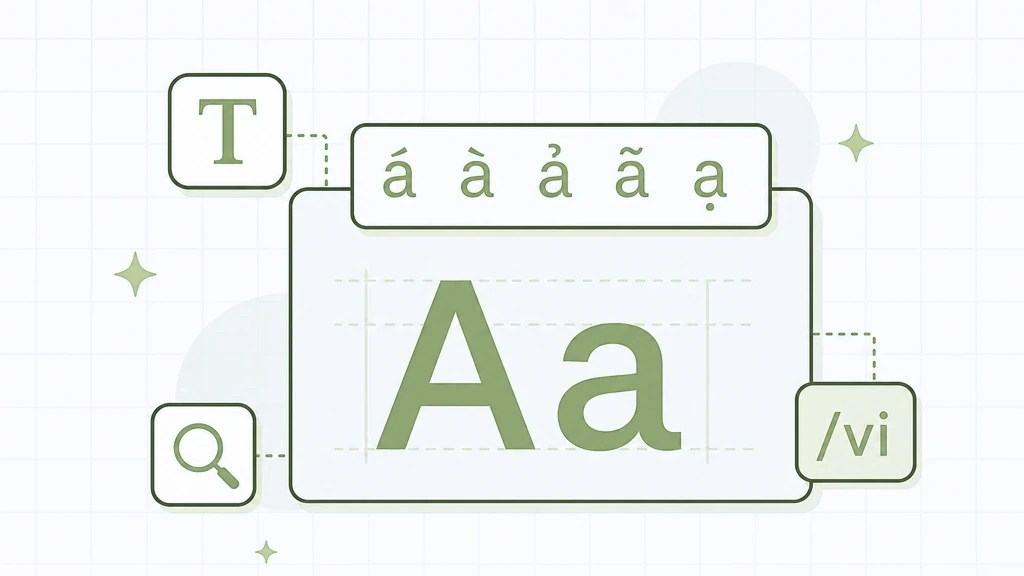
If your brief says “translate the website to Vietnamese,” stop treating diacritics as decoration. Vietnamese on the web is a tone-mark problem: unsigned ASCII (tieng Viet) does not look modern—it looks unfinished, and it can change meaning.
This article is a launch guide for a Vietnamese (vi) website version: locale choice, fonts and layout, crawlable URLs, checkout QA, MTPE vs human review, SEO pitfalls, and a checklist you can actually run.
What does it take to translate a website to Vietnamese beyond swapping strings?
Beyond CMS fields, you need a pipeline that preserves ă â ê ô ơ ư and tone marks through templates, email, PDFs, and slugs; fonts that still render those marks at small sizes; a real Vietnamese URL whose body is actually Vietnamese; and a register decision (everyday vs Sino-Vietnamese literary) before anyone opens a file.
Na te pytania odpowiada poradnik
- What does it take to translate a website to Vietnamese beyond swapping strings?
- Which Vietnamese locale or regional variants should you choose?
- What script, typography, and layout issues are unique to Vietnamese?
- How should URLs, hreflang, and indexing work for a Vietnamese site version?
- What onboarding and checkout nuances matter in Vietnamese?
- Should you use AI translation, MTPE, or human review for Vietnamese?
- What SEO mistakes specifically hurt Vietnamese pages?
- How do you launch and measure a Vietnamese website version?
Quick answer: translate your website to Vietnamese the right way
A durable Vietnamese launch looks like this:
- Treat tone marks as content. Unsigned Vietnamese on a public URL is a quality failure, not a speed hack.
- Wdróż
vi(częstovi-VN) pod osobnym, indeksowalnym adresem URL — nie jako przełącznik działający wyłącznie przez pliki cookie. - Prototype nav, cards, checkout, and emails with real Vietnamese copy so clipped marks and overflow show up before launch.
- Research queries the way people type them—including mobile input methods that drop or keep diacritics—then write on-page titles with correct marks.
- Zanim zwiększysz skalę, dodaj wzajemne wpisy hreflang, znaczniki canonical wskazujące wersje w tym samym języku oraz mapy witryny.
- Put product nouns in a glossary so MTPE cannot silently strip marks or flip register.
CSA Research’s survey of 8,709 consumers in 29 countries found 76% prefer buying with information in their own language and 40% will never buy from websites in other languages. That still holds when some Vietnamese speakers also read English: checkout, invoices, and support are where an English-only journey loses the sale. Google’s helpful-content guidance favors people-first pages; a Vietnamese nav around English body copy is a weak locale. For market-versus-language strategy, read how international SEO differs from multilingual SEO.
Choose the right Vietnamese locale
Most teams should ship vi with a Vietnam-oriented vi-VN URL if that is the first commercial market. That is a reasonable first release. It is not a license to mix unsigned chat-speak, Northern/Southern vocabulary, and literary Sino-Vietnamese in one file and call it “the Vietnamese locale.”
Vietnamese is one language with regional vocabulary and pronunciation differences. You can still architect one vi message file on day one. You should not pretend a Hanoi-flavored B2B glossary automatically sounds right for a Ho Chi Minh City consumer checkout. Put the audience and register in the brief: formal written UI vs everyday product voice.
Overseas Vietnamese readers exist, but currency, address formats, and legal pages still follow the market you sell in. A single vi file can be the right first ship if you are not localizing contracts yet—just do not treat diaspora English-mix copy as the source of truth for a Vietnam storefront.
Also decide how you will handle names, addresses, and phone numbers. Forms that reject Vietnamese characters, force ASCII-only names, or assume Western given-name / family-name order will fail after the strings look “translated.”
Vietnamese script, typography, and layout nuances
Vietnamese uses the Latin alphabet plus diacritics. Characters like ă â ê ô ơ ư and tone marks must survive CMS fields, emails, PDFs, and autogenerated titles. A font stack that only tested English will clip marks at small sizes or fall back to a face that makes ợ look like a broken o.
Zasady układu, które pozwolą uniknąć zrzutów ekranu z problemami w tygodniu premiery:
- Prototype key screens with real Vietnamese copy—including long compound words and tone-heavy headings.
- Increase line-height versus a Latin-first theme so marks have vertical room.
- Allow buttons to wrap; do not shrink type to keep a one-line English CTA.
- Ship production fonts with Vietnamese coverage in UI, email, and PDFs.
- Zwróć uwagę na tytuły kart, etykiety i nagłówki tabel — to w nich najpierw widać przycinanie tekstu.
Dates and numbers are part of the layout contract. Vietnam typically expects day-month-year in running text, period or comma conventions that match the market, and currency formatting for VND when you actually sell in Vietnam. Sorting Vietnamese lists as if they were English ASCII is not a collation policy.
Cadence matters. English CTAs are often abrupt. Vietnamese marketing copy can be warmer and more complete without becoming bureaucratic—while payment and error copy stay plain. Train reviewers to protect payment clarity while giving homepage enough room to sound like Vietnamese, not translated English.
Sino-Vietnamese literary register and everyday Vietnamese differ. Consumer products usually want clear everyday wording. Over-formal machine output is a common MT failure mode: it looks “correct” and still feels like a textbook.
Indeksowalne adresy URL, hreflang i indeksowanie
Google recommends different crawlable URLs for each language or region version rather than cookies or browser language alone. Google determines page language primarily from visible content—so a translated nav around English body copy is a weak Vietnamese version. Give Vietnamese its own folder or host pattern (/vi/, /vi-vn/) and keep that pattern consistent across templates, analytics, and internal links.
Hreflang annotations must be reciprocal across the alternate set you declare. Each locale URL should carry a clear canonical that prefers the same-language preferred URL when duplicates exist. Do not canonical a Vietnamese page to its English equivalent.
Bing Webmaster Guidelines emphasize crawlable, useful content and clear site structure across markets. Build once for shared foundations, then monitor Google Search Console and Bing Webmaster Tools where you operate both. Google advises against automatically redirecting users based on assumed language or location; offer a visible selector that links to the Vietnamese URL instead. IP-guessing “Vietnam → /vi” traps travelers, VPNs, and crawlers.
URL policy and on-page policy can differ: you may percent-encode or ASCII-fold a slug for operational reasons, but titles, H1s, and body copy should keep tone marks. Stripping diacritics for “cleaner URLs” and stripping them on the page hurts readability. If you fold slugs, redirect consistently; do not publish two competing Vietnamese URLs without a canonical.
Wdrożenie, budowanie zaufania i finalizacja zakupu w języku docelowym
Vietnamese trust pages do more work than a translated feature list. Sites that sell to Vietnam typically need privacy, terms, and (where relevant) payment and after-sales copy that read as real pages, not leftover English templates. That is not a ranking tactic; it is what users look for when they decide whether a checkout is legitimate. Treat those pages as first-class localization.
Practical Vietnamese conversion checks:
- Homepage, ads, and product UI use the same register (everyday vs literary).
- Forms accept Vietnamese characters for names and addresses, or they explain why a Latin field is required.
- Treści dotyczące plików cookie i zgód sprawdzono w rzeczywistym banerze — są długie i źle się zawijają.
- Pricing, invoices, and currency language match the market you claim to serve.
- Support macros and transactional email keep tone marks; a “safe ASCII” email template is a leak.
- Komunikaty o błędach wskazują rozwiązanie, zamiast ograniczać się do uprzejmych, pustych przeprosin.
- Mobile typing: people may search or fill forms with or without marks depending on the keyboard—QA both, but do not ship unsigned UI as the official voice.
Nie musisz od razu publikować wszystkich wpisów na blogu. Potrzebujesz jednak strony głównej i objaśnienia produktu, uwierzytelniania, cennika, kasy i rozliczeń, podstawowych informacji o prywatności, punktów kontaktu z obsługą oraz stron prawnych oczekiwanych na danym rynku.
The myth that “Vietnamese buyers will just use English” is only half true. Some will browse docs in English. Enough will not complete checkout, billing, or support in English that you still leave money on the table.
AI, MTPE i weryfikacja przez człowieka dla tego języka
Should you use AI translation, MTPE, or human review for Vietnamese? Use risk to choose the workflow—not tool branding:
- Raw machine translation: fine for internal drafts only. Models drop tone marks, mix registers, and produce textbook Sino-Vietnamese on consumer screens.
- MTPE (machine translation + post-editing): a solid default for many product and support pages when the glossary locks product nouns and a diacritic check exists.
- Tłumaczenie przez człowieka / redakcja pod kątem marki: strona główna, cennik, kampanie, komunikaty o plikach cookie i zgodach oraz wszelkie strony związane z kwestiami prawnymi.
A practical review loop for Vietnamese:
- MTPE draft against the glossary (marks and register locked).
- Weryfikacja przez redaktora marki: strona główna, cennik i kluczowe strony docelowe.
- Product linguist pass on errors, billing, and dynamic UI—especially clipped marks and buttons.
- Staging QA in Vietnamese at mobile widths, including email and PDF renders.
- Add a publishing check that flags suspiciously ASCII-only Vietnamese body copy on
viURLs.
People-first helpful content expectations apply in every language. Low-quality machine-only Vietnamese pages can look complete in a CMS while still failing users and search quality bars.
Vietnamese-specific SEO pitfalls
Vietnamese searchers look for language they can read. Translating English head terms word-by-word, or ranking unsigned ASCII titles, misses how people actually search. Do Vietnamese keyword research, then write titles and H1s that sound like Vietnamese results pages—with tone marks.
Localize titles, meta descriptions, and headings per Vietnamese URL. Do not reuse one English metadata set across locales.
Mistakes that specifically hurt Vietnamese pages:
- Unsigned Vietnamese on titles, buttons, or body copy.
- Boilerplate-only translation — chrome Vietnamese, body still English.
- Brakujące glify w produkcyjnych czcionkach, wiadomościach e-mail lub plikach PDF.
- Cookie-only language switches that hide the Vietnamese URL from crawlers.
- Nieprawidłowe hreflangi (brak linków zwrotnych).
- Automatyczne przekierowania geograficzne, które blokują użytkowników i boty.
- Stripped-ASCII pages treated as the language version.
- Ubogie wersje językowe oparte wyłącznie na tłumaczeniu maszynowym, które nie spełniają wymagań dotyczących pomocnych treści.
Fix marks, fonts, and architecture before you scale content volume. Tooling should enforce the process—not invent ranking promises.
Lista kontrolna przed uruchomieniem
Use this checklist when you are ready to ship Vietnamese:
Rola GlotEO
Vietnamese is a strong fit for translation memory: product nouns recur, and they must not lose tone marks in the next English drop. Glossary and memory in the website localization platform keep marks, register, and feature names stable while layout-tested copy ships. Pair that with multilingual SEO tooling so Vietnamese URLs, hreflang, and metadata stay reviewable as you expand. Compare GlotEO pricing and plans when you scope the first vi release, or start from a broader website translation workflow if you are still choosing languages.
Poznaj lokalizację stron internetowych GlotEO, gdy słowniki JSON i nieoznaczone wersje robocze z tłumaczenia maszynowego przestaną być bezpiecznym sposobem publikowania treści vi.
Źródła
- Źródło wytycznych przytoczonych w tym artykule (Wytyczne Bing Webmaster)
- Potwierdza zalecenia przytoczone w tym artykule (Nie umiesz czytać, nie kupisz – B2C: konsumenci wolą posługiwać się własnym językiem)
- Źródło wytycznych przytoczonych w tym artykule (Jak określić kanoniczny adres URL za pomocą rel=canonical i innych metod)
- Źródło wytycznych przytoczonych w tym artykule (Tworzenie przydatnych, rzetelnych treści stawiających ludzi na pierwszym miejscu)
- Źródło wytycznych przytoczonych w tym artykule (Poinformuj Google o zlokalizowanych wersjach swojej strony)
- Źródło wytycznych przytoczonych w tym artykule (Zarządzanie witrynami wieloregionalnymi i wielojęzycznymi)