



Internationaal zoekwoordenonderzoek
Een marktgerichte aanpak voor meertalig zoekwoordenonderzoek: taal- versus landgerichte strategieën, lokale SERP-validatie, URL-matrices en metingen in Search Console—zonder alleen Engelse zoekwoorden te vertalen.
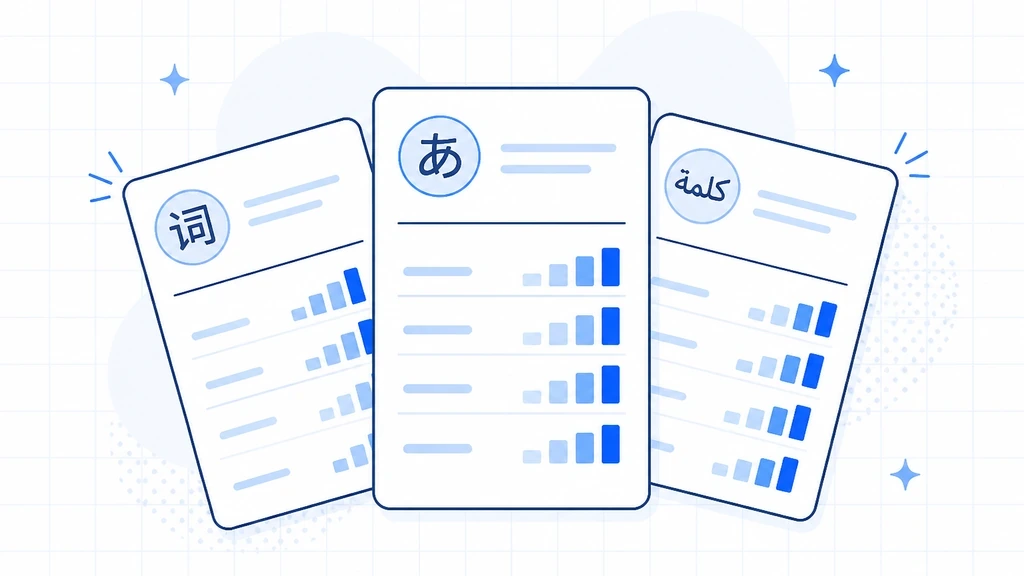
International keyword research is not a translation exercise. Search demand, query language, and SERP layouts differ by market even when the product is identical. Teams that export English seed lists through a dictionary—and call it research—often publish crawlable language URLs that do not match how people actually search locally.
This guide teaches a market-first process: frame language versus country targeting, build seed lists per market, validate intent in local SERPs, and connect findings to URL and content matrices—grounded in Google’s multilingual site guidance, not invented ranking shortcuts.
Vragen die deze gids beantwoordt
- Why is translating English keywords insufficient for international SEO?
- How should language targeting and country targeting change keyword sets?
- What process builds seed lists per market?
- How do you validate local search intent and SERP features?
- How should keyword research inform URL and content matrices?
- How do you handle one language across multiple countries?
- What tools and Search Console signals support ongoing research?
- Which international keyword research mistakes are most common?
Quick answer: research demand in-market, do not only translate
Quick answer: Research keywords in each target language and market using local tools, SERP inspection, and post-launch Search Console data—not by translating English seeds word-for-word. Google distinguishes multi-regional and multilingual sites; your keyword sets should follow whether you target languages, countries, or both. Geotargeting signals are imperfect; local language, currency, and on-page cues still matter alongside hreflang and URL structure.
Translating English keywords tells you what words could be used. It does not tell you what users do search for, which SERP features appear, or whether intent matches your page type.
Language vs country keyword frames
How should language targeting and country targeting change keyword sets?
Google defines multilingual sites as offering content in more than one language and multi-regional sites as explicitly targeting users in different countries. Keyword planning must mirror that split:
| Frame | Keyword question | Example |
|---|---|---|
| Language | How do speakers of this language query? | French queries for Canada vs France |
| Country | How do buyers in this market query in their preferred language? | German queries in Austria vs Germany |
| Combined | Which language × country cells need distinct URL targets? | en-US vs en-GB pricing terms |
When you target a language globally, one keyword set may suffice with regional spelling variants noted. When you target countries separately—even in one language—currency, shipping, regulations, and competitive SERPs can change the keyword list entirely.
Google recommends different crawlable URLs for each language or region version rather than relying on cookies or browser language alone. Keyword research should inform which URLs earn investment, not the reverse.
Google advises against automatically redirecting users based on assumed language or location, and recommends a user-visible language or country selector. Research should respect that users may land on the “wrong” locale URL and switch manually.
Seed list process per market
What process builds seed lists per market?
Use a repeatable pipeline per language or country cell:
- Define the cell — language only, country only, or combined (e.g.,
es-MX) - Gather jobs-to-be-done — interviews, support tickets, sales calls, existing analytics
- Collect competitor and SERP-visible terms — inspect top results in the local Google interface (or Bing where relevant)
- Expand with local-language tools — autosuggest, related searches, People Also Ask
- Merge English source concepts as hints only — map ideas, not literal strings
- Dedupe and cluster — group by intent (informational, commercial, transactional)
- Prioritize by business fit — not raw volume alone
- Document approved phrasing — feed localization glossaries where terms are stable
Each cell gets its own seed document. Shared languages across countries (Spanish in Mexico and Spain, English in the US and UK) still warrant separate passes when SERPs or offers differ.
Intent and SERP validation
How do you validate local search intent and SERP features?
Volume metrics without SERP context mislead international teams. For each priority cluster:
- Search the term in the target market interface (correct country proxy or native reviewers)
- Classify intent: guide, comparison, product page, local pack, etc.
- Note SERP features: AI Overviews, featured snippets, video, marketplace dominance
- Compare winning page types—not just keywords—to your planned template
- Flag English-only SERP dominance (may signal need for localized proof, not English reuse)
Google determines page language primarily from visible content; language versions should keep content and navigation predominantly in one language. Intent validation ensures you build the right page type in the right language—not a translated blog post where the SERP expects a product comparison.
Google helpful-content guidance prioritizes people-first pages; thin or boilerplate-only language versions are weak SEO and weak answer sources. If local intent requires market-specific examples, pricing, or compliance copy, keyword approval should trigger localization depth—not word-for-word translation.
From keywords to content and URL matrices
How should keyword research inform URL and content matrices?
Turn keyword clusters into an explicit matrix:
| Market cell | Primary cluster | Page type | URL pattern | hreflang code |
|---|---|---|---|---|
| de-DE | “website übersetzen” | Guide | /de/blog/... | de-DE |
| fr-CA | “traduction site web” | Guide | /fr-ca/... | fr-CA |
Rules of thumb:
- One primary intent per URL; avoid multi-intent mashups
- Align title, H1, and body language with the approved local cluster
- Hreflang annotations tell Google about alternate language or regional URLs and must be reciprocal across the set of pages they describe
- Each language or locale URL should have a clear canonical that prefers the same-language preferred URL when duplicates exist
- XML sitemaps help discovery of language versions and can carry hreflang annotations when used as an implementation method
Keyword research should drive which rows exist in the matrix—not justify cloning every English URL regardless of demand.
Shared language across countries
How do you handle one language across multiple countries?
English in the US and UK, Spanish in Mexico and Spain, and Portuguese in Brazil and Portugal are common pain points.
Options:
- Single URL with generic language code (
en,es) when content truly serves all speakers and offers do not differ - Regional URLs (
en-US,en-GB) when pricing, shipping, spelling, or regulatory copy differs - Hybrid — global
enfallback plus regional overrides for high-stakes pages (pricing, legal)
Geotargeting signals are imperfect; local language, currency, and on-page cues still matter alongside hreflang and URL structure. Even with regional hreflang, inspect whether SERPs differ enough to warrant separate keyword targets and page templates.
Provide user-visible switchers; do not force redirects that hide alternate versions from crawlers and users.
Measurement with Search Console and analytics
What tools and Search Console signals support ongoing research?
Official search documentation does not prescribe a single keyword toolchain. Treat tool choice as operational. Google Search Console (and Bing Webmaster Tools where indexed) supplies post-launch truth:
- Queries and pages filtered by property or subdirectory per locale
- Impressions and CTR shifts after localization
- Index coverage and hreflang errors after matrix changes
- Compare query language to on-page language for drift
Bing Webmaster Guidelines emphasize crawlable, useful content and clear site structure for indexing across markets—measurement should confirm Bing can crawl locale URLs you care about, not only Google.
Refresh seed lists quarterly in mature markets; monthly during aggressive launch phases. Feed winning queries back into glossaries as approved variants.
Implementatiechecklist
Veelgemaakte fouten
Which international keyword research mistakes are most common?
- Translating English seeds verbatim without local SERP validation
- Ignoring country differences within the same language
- Choosing URLs before research and forcing keywords to fit
- Treating volume as intent without inspecting SERP layout
- Skipping glossary handoff so approved terms drift in translation
- Publishing thin translated templates that fail helpful-content expectations
- Cookie-based locale switching without crawlable language URLs
- Non-reciprocal hreflang after launching matrix rows
- Same-language duplicates without clear canonical preference
- One-time research with no Search Console feedback loop
Deeper SERP validation patterns
When validating intent, capture three artifacts per priority cluster: a screenshot or notes on dominant page type, a list of recurring modifiers (pricing, free, enterprise, near me), and whether results skew editorial or product-led. Clusters where the SERP shows local packs, marketplaces, or AI Overviews may need different templates than a translated English blog post.
Re-run validation when Google refreshes SERP layouts in a market—especially for YMYL topics where local compliance language appears in titles. A keyword that looked informational six months ago may have shifted commercial.
Connecting research to glossaries and translation
Approved keyword phrasing should flow into localization glossaries as preferred renderings—not as mandatory insertions in every sentence, but as constraints on titles, H1s, and anchor text where research supports it. This closes the loop between SEO research and translation quality: linguists see why a term matters, and SEOs trust published copy to reflect local demand.
Without glossary handoff, teams often publish crawlable URLs whose visible language does not match the queries they researched—undermining both user trust and the clarity Google expects from people-first pages.
Budget mistakes that look like research
Which international keyword research mistakes are most common? Beyond the list above, watch for:
- Researching once per language when country SERPs differ materially
- Letting English information architecture dictate local content types
- Ignoring zero-volume strategic terms that appear in sales cycles but not keyword tools
- Skipping Bing validation in markets where Bing share matters for B2B
- Launching hreflang clusters before keyword-to-URL mapping is stable—forcing rework across annotations
Research is cheaper than rewriting fifty localized URLs because hreflang and canonical rules were built on the wrong intent map.
Tooling boundaries
Official Google and Bing documentation describe crawlability, language clarity, and helpful content—they do not endorse a single keyword research product. Treat tools as interchangeable inputs to the process above: local autosuggest, SERP scraping, Search Console, analytics landing pages, and customer language from support tickets.
Document which tool produced each seed list so teams can reproduce research during audits. The process matters more than the vendor logo on the export.
Matrix maintenance
URL and content matrices are living documents. When English pillars rename or merge, update matrix rows before retranslation propagates outdated paths. Pair matrix changes with hreflang regression checks—reciprocal annotations break silently when URLs move but annotations lag.
For shared languages across countries, maintain a column for spellingVariant, currency, and legalOwner so keyword research maps to the correct regional URL—not an assumed default.
Post-launch iteration cadence
Schedule a 30-day and 90-day review for each new locale cell. At 30 days, inspect index coverage and first-query impressions in Search Console; at 90 days, compare winning queries to your seed clusters and update glossaries with phrasing that already earns visibility. Markets that underperform often need template changes—not more translated pages from the English backlog.
Invite localization leads to these reviews so keyword learnings become enforced terminology rather than one-off SEO notes.
Keep a “SERP snapshot” appendix per cluster: date, market, dominant page types, and notes on regulatory language in titles. Future you—and future vendors—will need that context when refreshing seeds.
Document who owns each market cell in the matrix so research updates do not stall waiting for a single global SEO lead.
De basis voor traditionele zoekmachines en antwoordengines
Shared foundations for in-market keyword research feeding locale content still matter across Google, Bing, and answer engines: crawlable language versions, clear entities, evidence-backed claims, structured data where truthful, and real localization—not English-only shells. Treat the guides below as platform-specific lenses on the same multilingual delivery bar.
Platformgids: Google Zoeken
In Google Zoeken hangt vindbaarheid af van crawlbare URL's per taalregio met HTML in de juiste taal, passende titels en koppen en wederkerige hreflang-tags wanneer er alternatieven zijn. De technische basis bestaat uit indexeerbare content (niet alleen via cookies geactiveerde taalwissels), gelokaliseerde metadata, sitemaps en zorgvuldig gebruik van canonieke URL's. Kwalitatieve content begint bij hoofdcontent die in elke taal voor mensen is geschreven; autoriteit komt voort uit een herkenbare organisatie-identiteit en bevestiging door betrouwbare bronnen — niet uit marketingclaims over vertaaltools. Voor meertalige sites betekent dit dat elke URL voor een markt of taal op zichzelf moet staan. Meet de resultaten per taalregio met de dekking in Search Console en URL-inspectie. Bekend en onzeker: Google documenteert hoe meertalige content en hreflang werken, maar garandeert geen hogere posities op basis van een CMS of MTPE-workflow.
Platformgids: Bing
Bing ontdekt en indexeert crawlbare meertalige pagina's met een duidelijke structuur, vergelijkbaar met Google, dat heldere URL's en content verwacht. De technische basis bestaat uit bereikbare URL's per taalregio, nuttige content en monitoring via Bing Webmaster Tools. Geef de voorkeur aan gelokaliseerde koppen, claims en FAQ's boven een vertaling die alleen UI-elementen aanpast. Signalen van autoriteit blijven afhankelijk van betrouwbare bronnen en consistente entiteiten. Voor meertalige sites betekent dit: verberg talen niet achter schakelaars die alleen aan de clientzijde werken. Meet de indexering en crawlstatistieken in Bing Webmaster Tools. Bekend en onzeker: de richtlijnen van Bing benadrukken crawlbare, nuttige content; verzin geen specifieke rankingfactoren van Bing voor vertaaltools.
Platformgids: ChatGPT
ChatGPT kan verwijzen naar openbaar toegankelijke pagina's of deze samenvatten als de taalversies duidelijk zijn en geschikt zijn om vragen te beantwoorden. Dit is geen traditionele crawlranking: zichtbaarheid betekent dat een pagina als bron wordt geselecteerd of in antwoorden wordt genoemd. De technische basis begint nog steeds bij toegankelijke HTML-URL's — niet bij widgetlagen die tekst verbergen. Nuttige contentkenmerken zijn directe antwoorden, FAQ's en consistente terminologie uit woordenlijsten. Autoriteit komt voort uit bewijs en consistente entiteiten in alle taalregio's. Voor meertalige sites betekent dit dat elke pagina in een taalregio zelfstandig leesbaar moet zijn. Meten is lastig: zie controles op vermeldingen als hypotheses. Bekend en onzeker: er is geen gedocumenteerde garantie dat MTPE of een CMS-integratie vermeldingen in ChatGPT oplevert.
Platformgids: Gemini
Gemini en verwante AI-functies van Google zijn gebaat bij consistente entiteiten, waarheidsgetrouwe gestructureerde gegevens en indexeerbare pagina's in de juiste taalregio. Het draait om vermeldingen of herkenning — niet om het verzinnen van rankingfactoren voor Gemini. De technische basis overlapt met de crawlbaarheid en metadatakwaliteit van Google Zoeken. Content moet duidelijke claims en definities in elke taal bevatten. Autoriteit hangt af van een consistente organisatie-identiteit en bevestiging door betrouwbare bronnen. Voor meertalige sites verkleinen productnamen die volgens een woordenlijst worden beheerd de kans op verwarring tussen taalregio's. Meet op de gebruikelijke manier via Search Console en beoordeel daarnaast steekproefsgewijs AI-antwoorden. Bekend en onzeker: het gedrag van Gemini vervangt de gedocumenteerde richtlijnen van Google Zoeken voor hreflang en taalversies niet.
Platformgids: Google AI Overviews
Google AI Overviews kan verwijzen naar ondersteunende pagina's; de criteria zijn nog steeds gebaseerd op content die voor mensen is geschreven en indexeerbaar is. AI Overviews vervangt geen taalwisselaar en geen hreflang. De technische basis blijft crawlbare HTML-pagina's per taalregio en waarheidsgetrouwe gestructureerde gegevens. Nuttige contentkenmerken zijn beknopte antwoorden en duidelijke koppen in elke taal. De autoriteitssignalen komen overeen met de verwachtingen voor behulpzame content. Voor meertalige sites betekent dit dat opname in AI Overviews voor geen enkele vertaalde pagina gegarandeerd is. Meet met generatieve rapporten in Search Console, als die beschikbaar zijn, en houd traditionele indexeringscijfers apart. Bekend en onzeker: geen enkele vertaalworkflow kan een plaatsing in AI Overviews garanderen.
Waar GlotEO van pas komt
International keyword research connects to execution: approved terms, localized drafts, and crawlable language URLs must stay aligned. GlotEO multilingual SEO platform helps teams tie research outputs to briefs, glossaries, and publishing workflows instead of losing clusters in disconnected spreadsheets.
Pair research with how international SEO differs from multilingual SEO when framing language versus country targets. Review GlotEO pricing and plans when scaling research-driven locale expansion across many URLs.
Explore GlotEO multilingual SEO to operationalize market-first keyword research alongside translation and site architecture work.
Bronvermeldingen
- Ondersteunt de richtlijnen waarnaar in dit artikel wordt verwezen (Richtlijnen voor Bing-webmasters)
- Ondersteunt de richtlijnen waarnaar in dit artikel wordt verwezen (Een canonical-URL opgeven met rel=canonical en andere methoden)
- Ondersteunt de richtlijnen waarnaar in dit artikel wordt verwezen (Nuttige, betrouwbare en mensgerichte content maken)
- Ondersteunt de richtlijnen waarnaar in dit artikel wordt verwezen (Google informeren over gelokaliseerde versies van je pagina)
- Ondersteunt de richtlijnen waarnaar in dit artikel wordt verwezen (Meertalige en multiregionale websites beheren)
- Ondersteunt de richtlijnen waarnaar in dit artikel wordt verwezen (Meer informatie over sitemaps)